Saturday, July 25, 2020

Stephen Kirk

The seventh person mentioned in the division of land in the John Kirk Dec’d estate file is Stephen Kirk.

Division the 7th Lot No 2 valuation $475 to Stephen Kirk lying on Lick Creek and Clover Fork lying in two different tracts first tract on Lick Creek beginning at a post oak and runs thence east eighty poles to a pine thence north 56 poles to a pine by a pine pointer thence north 54 west 114 poles to a post oak thence south 45 west 20 poles to a post oak thence north 45 west 70 poles to a hickory by a post oak thence south 10 west 76 poles to a red oak on Merrimon’s line thence with is line south 63 west 78 poles to a post oak thence north on other of said Merrimon’s line south 16 west 169 poles to a small red oak thence south sixty poles to a stake between two red oaks and a blackjack pointer thence east sixty four poles to a hickory thence north to and with George Hearn's line to the beginning containing one hundred and fifty one acres. Second tract lying on the head of the clover fork beginning at a sassafras by two red oak pointers William Crowel's corner and runs with his line south fifty four west 118 poles to a post oak Moors old corner thence south 26 east 52 poles to a Spanish oak maple and red oak pointers thence north 65 east 112 poles to a stake by a white oak red oak and sassafras pointers thence south 25 east 76 poles to Watkins line thence as his line north 52 poles thence north 36 west to the beginning containing 56 acres the two tracts contain in the whole two hundred and six acres.


Stephen Kirk was born about 1795 in Montgomery County, North Carolina. I can pin him to the 1800 and 1810 Census living with his father, John Kirk, as a child. The 1820 Census was destroyed, thus the next possible record to find Stephen on is the above survey dated 1818, showing the survey of the land he inherited when his father, John, died.


In September 1818, Stephen, now 23 years of age, enters two land grants for 15 and 30 acres of land joining his father’s, John Kirk dec’d, and the Rowan County and Montgomery County line. Both tracts of land were surveyed by Britain Chappell and chain carriers were brothers, James, Parham, Daniel, and Lewis.


A great substitute for the 1820 Census is Newspapers if you can find your ancestor listed. I can establish that Stephen Kirk was in Montgomery County, North Carolina because John Patterson ran an ad for a $20 reward for a runaway slave by the name of Simon, who was a Blacksmith by trade. John Patterson notes in his ad that Simon is thought ‘to be in the neighborhood of Allenton’ or on the property of Stephen Kirk in Montgomery.


In 1823, 1828 and 1839, another 190 acres of land would be acquired by Stephen, and another 163 acres by 1848.


Stephen Kirk looks to have settled down to raise a family about 1816, when son, Lewis, was born. I found a wide range of dates when researching the children of Stephen Kirk. From Stephen’s will, I know Lewis was his eldest son and Jane (Parker) was his eldest daughter, as he calls them such in his will. Based on the 1830 Census, the best I can calculate the ages of the children are as noted below.

Most research I read in preparation of this Blog post suggests that Stephen married Edith Kimball, daughter of Buckner Kimball. However, I have found zero evidence as to who Stephen Kirk’s first wife is. If anyone knows, please leave a comment with the information and where I can find the documented proof.


By 1840, some of the older children look to have moved from the household but Stephen and wife have had some additions since the last Census. (Note: Kimball is also seen as Kimbrell and Kimble)


Unlike Census data between 1790 and 1840, the 1850 Census lists, by name, all those is the household. It also shows who is missing. From this Census we can tell that Edith, the wife of Stephen, must have died between 1841, when Kimble was born and 21 Aug 1850, when the Census was enumerated. Children remaining at home with Stephen, their father, are Edith, Ezra, Carrol, Jesse and Kimbrell.


On 2 Oct 1851, a little over a year after the 1850 Census was enumerated, the Carolina Watchman, a paper out of Salisbury, North Carolina, announced the marriage of Stephen Kirk to Syntha Goodman, whom Stephen lists as Cynthia is his will, and the step-mother of his two youngest sons Jesse and Kimbrell.


Stephen Kirk wrote his will on 17 May 1852 in Stanly County, North Carolina.
First: I give to my (wife) Cynthia Kirk...three beds and two steeds all her bedding furniture she brought with her and the other property that she brought with her also one end of my dwelling house and one third of my plantation during her natural life or widow hood
Second: I give to my eldest son Lewis Kirk 150 acres where he now lives and other advancements
Third: I give to my eldest daughter jane Parker 100 acres where she now lives and other advancements
Fourth: I give to my son Atlas Kirk 140 acres where he now lives and other advancements
Fifth: I give to my son Ezra Kirk 170 acres, bed and furniture, cow and calf and other advancements
Sixth: I give to my daughter Mary Harris $200, one cow or the worth of one cow with other advancements
Seventh: I give to my daughter Nancy Miller $200 and other advancements
Eighth: I give to my daughter Elizabeth Lentz 200 acres where she now lives and other advancements
Ninth: I give to my daughter Rebecca Foutz $200 and other advancements
Tenth: I give to my youngest daughter Edith Miller one small negro girl slave named Caroline with other advancements...if Edith dies and leaves no child the negro girl and her increase if any to be sold and equally divided among the rest of my children
Eleventh: I give to my son Carrol Kirk 251 acres of land in different tracts, one horse saddle and bridle, one bed and furniture, one cow and calf, and sufficient farming tools to carry on farming
Twelfth: I give to my two youngest sons Jesse and Kimbrell Kirk all my tract of land I now live to be equally divided between them. My desire is that Jesse and Kimbrell support their stepmother as long as she will stay with them. Also, one bed and furniture one horse saddle and bridle each and the balance of the stock, farming tools and old black smith tools, one wagon and hind gear and necessary household and kitchen furniture


Lastly, I want to mention that while researching Stephen Kirk and his family, I noticed what looks to be a discrepancy with daughter, Edith. The 1850 Census lists Edith Kirk as 20 years old, making her born about 1830, living in household of Stephen Kirk, her father.

Stephen Kirk’s will was written in 17 May 1852 and mentions Edith Miller as his youngest daughter, with no children. So, Edith Kirk Miller was married to a man with surname Miller between 1850 when the Census was enumerated and 1852 when Stephen Kirk wrote his will.

Every tree that I have reviewed on Ancestry lists Edith as born in 1812 and the wife of John Franklin Miller. While there is a John F and Edith (age 38) Miller listed on the 1850 Census, I just cannot see how this can be Edith, daughter of Stephen Kirk, as Edith Kirk would have been 4 years old when Jane Miller, the eldest child of John Miller, was born. Stephen Kirk, born about 1795, would have only been 17 years old when Edith was born. Stephen Kirk’s will specifically states that Jane Parker is his eldest daughter… “I give to my eldest daughter Jane Parker”

Find-A-Grave lists Edith as the daughter of Stephen and Cynthia Kirk but this cannot be as Stephen Kirk did not marry Cynthia until 1851, 21 years after Edith was born. Cynthia is named in Stephen Kirk’s will as the stepmother of his two youngest sons, Jesse and Kimbrell, who were born after Edith, according to the 1850 Census.

A scenario I can see is that Edith Kirk lied about her age as she married a man much older than herself who already had 6 children. The 1850 Census shows John F Miller was born in 1804. He has children ranging from 7 to 16, and a 1 year old. This indicates to me that the Edith Miller listed may be a second wife.

Saturday, July 18, 2020

Nancy Kirk Jones and Rebekah Kirk Jones

The sixth and eighth persons mentioned in the division of land in the John Kirk Dec’d estate file are Nancy Jones and Rebekah Jones.

Division the 6th and Lot No 4 valuation $175 to Nancy Jones beginning at a black oaks the beginning corner of the old hundred and fifty acre survey near the west bank of the Yadkin River and runs south forty five west 175 poles to a small red oak thence south 45 east 155 poles to a small hickory thence north 45 east ?75 poles to a sassafras by a red oak pointer near the west bank of said river


Division the 8th and Lots No 8 valuation $250 to Rebekah Jones lying in two tracts adjoining one tract of 150 acres called the Walkr (Walker?) field tract beginning at a post oak by a read oak pointer courses not known but may be had by having reference to the Petition (?) granted to sd John Kirk Dec’d also fifty acres adjoining the same survey William Harris and Richard Parker's lines and Stephen Kirk's also.


I have spent the last few weeks reading everything I could get my hands on about the Jones family who lived near the Kirk family on the west side of the Yadkin / Pee Dee River in Montgomery County, North Carolina. I still cannot say who these sisters married. As both husbands have the surname Jones, it is likely that they were related, and could be brothers. It is not uncommon for sisters to marry brothers. My own Marks and Gunter ancestors certainly did.

A Charles (and Thomas) Jones shows up on the 1790 Census for Montgomery County. From the 1800 Census, Charles looks to have been born before 1755 based on age range. He is living 2 doors down from John Kirk, the father of Nancy and Rebekah, so it is very probable that the Jones and Kirk families know each other. In 1810, Charles lives next door to a Moss and Forrest family, of whom, children of John Kirk, married into. It could be that these sisters married sons of Charles Jones.

Charles is shown residing in Anson County as he signed the petition to divide Anson to form Montgomery in 1777. He entered his first land grant in Anson County, around the same time that Montgomery was formed from Anson, and that land grant was issued in Montgomery County. Two more tracts of land were surveyed for Charles in 1799 and 1818, although the later could be for a son.


Clearly Nancy Kirk and Rebekah Kirk married into the Jones family, however, to which Jones each married, it is yet to be discovered.

Sunday, July 5, 2020

Daniel Kirk

The fifth person mentioned in the division of land in the John Kirk Dec’d estate file is Daniel Kirk.

Division the 5th Lot No 1 valuation $500 to Daniel Kirk. Lying on the south side of Lick Creek beginning at the same corner of Lot No three a pine by a hickory and post oak pointer and runs with the last line of lot No 3 reverse south forty five east 115 poles to a pine by a red oak thence with another line of said lot south 45 west 112 poles to a post oaks thence south 45 east 108 poles to a Spanish oak thence north 45 east 196 poles to a small hickory thence north 45 west 221 poles to a post oak by a hickory and red oak pointers thence north 45 west 84 poles to the beginning. Containing one hundred and ninety acres.


The first Census I found for Daniel Kirk is 1810, Captain Kirks, Montgomery County, North Carolina. This record shows no females living with Daniel Kirk. The Census captures two white males, one between the ages of 10-15, and another, presumably Daniel, age between 16-25, making his birth year about 1789. The white male between 10-15 cannot be the son of Daniel as he was born about 1798 and is only about ten years younger than Daniel, perhaps this boy is a nephew or neighbor or orphan who resides and works with Daniel. The number of enslaved people is shown as 5. It is assumed that Daniel is single in 1810 as no females or younger children are shown on this Census in his household.


As the 1820 Census was destroyed, other records must be used to locate Daniel Kirk for that year. On 15 Oct 1819, Daniel Kirk entered a land grant for 50 acres of land in Montgomery County joining the lines of his father, John Kirk Dec’d on the south west side of the Yadkin River. Three months later, 15 Jan 1820, the entry taker, D. McRae, ordered the survey of the land. The survey was completed 20 Jan 1820 by Britain Chappell.


The 1830 Census does capture the Daniel Kirk family, including females and enslaved people. It is believed that Daniel married Mary Forrest about 1818/19 as their first child, James Franklin Kirk, was born about 1820. I have attempted to locate any documentation that Mary’s maiden name is Forrest. To date, I have located none and believe that the research that has been done over the years has, by reason of logical assumption based on record association, shown the best surname candidate for Mary’s maiden name is Forrest.


Most trees on Ancestry have Mary listed as the daughter of Nathan Forrest but have no documented evidence of the same. I did find in tombstone records for Badin Baptist Church in Badin, Stanly County, North Carolina, a listing that states the parents of James Franklin Kirk are Daniel Kirk and Mary (Polly) Forrest. This is not accepted as actual proof that Mary’s maiden name is Forrest but is a clue that needs to be investigated further. The record was typed around 1968 from handwritten copies of cemetery records done by David Kirk Shaver Senior and B. W. Cruse.


In 1835, a 100-acre tract of land located on the waters of the Yadkin River in Montgomery County, adjoining the land of Nathan Forrest Dec’d, was surveyed by Lockey Simmons, for Daniel Kirk. The land also joined that of Kinchen Pennington and Alfred Randle. David Pennington and Alfred Randle served as chain carriers.


In 1838, the inhabitants on the west side of the Pee Dee River signed a petition to divide Montgomery and form a new county. The Pee Dee River neatly divided the land from north to south and the courthouse was located some three miles from the river, proving a hardship for those residents who lived west of the river. Daniel Kirk, located in District Number 6, signed the petition to divide the county.

On 2 Dec 1840, a Fayetteville Newspaper, reported that “Mr. Lilly presented a petition from the citizens of Montgomery, with a bill to carry the prayer thereof into effect, entitled a bill to lay off and establish a new county by the name of Stanly. Read first time and passed.”

13 Jan 1841, a Wilmington Newspaper reported the newly created county of Stanly from Montgomery.

19 Feb 1841, a Raleigh Newspaper reported the act passed to create Stanly from Montgomery County.

7 May 1841, a Raleigh Newspaper reported the marriage between Mr. Hudson to Miss. Mary Pennington and Mr. Truxton Kirk to Miss. Tabitha Biles. To date, I have not been able to find proof of parentage for Truxton Kirk.


The 1840 Census shows the Daniel Kirk family living west of the Pee Dee River in Montgomery (soon to be Stanly) County. A total of 34 persons, including 26 enslaved persons, are living on the estate of Daniel Kirk.


Daniel Kirk wrote his last will and testament on 27 Oct 1846 in the presence of David Pennington and Dr. Francis J. Kron. His four-page will laid out his last wishes for his family and his estate, “in a manner to promote the welfare and maintain the harmony of my family...whilst my mind has yet its natural strength and my memory its full recollection.”

Daniel’s wish is that a “full years provision for my whole family set aside” and the balance (including enslaved persons if necessary) “sold to pay lawful debts” although later on in his will, Daniel states that it is his desire “all the slaves not be sold to pay the debts as above stated.”

“$500 bequeathed to each of my sons, James F and Adam over and above their shares for the consideration of their bodily infirmities”

The “slaves shall be divided unto nine lots by Samuel P. Morton, Francis Locke, and Mark Jones, with one exception, that Mary, my wife, shall chose for herself, with the other eight lots drawn for by the hand of a child.”

Daniel lays out how the lots are to be bequeathed, “the first lot drawn shall belong to the children of deceased daughter Martha Parker and the other lots successively to the other children.”

He also states that “the share that I possess in the Bunnell tract of land shall go to the children of Martha Parker.”

To daughter Eva Eddleman “the balance of the old home tract not sold to James Parker and the note of $500, the later gave for two hundred acres of the same tract, leaving it optional for James Parker to pay the $500 or return the land” which would remain under Eva's control.

Daniel completes his will by equally dividing “the balance of the lands among the other six remaining children."

Instruction is given that "Mary, my wife, shall have at her option during her life, either the home tract or the John Forrest tract and the enjoyment of the income from the Mill, which at her death shall be sold and the proceeds equally divided among all the children.”

Lastly, Daniel names his son, “James Franklin Kirk shall have the guardianship of the children underage and shall be sole executor of this last will and testament.”


As noted in Daniel’s will, James Kirk became guardian for the younger children. Archives for Stanly County show James providing returns as guardian for his younger siblings in 1847 and 1848, proving that Daniel Kirk died prior to Nov 1847.


Mary lived long enough to be enumerated for the first time by name on 6 Aug 1850. All other Census records just noting her as / mark as a female. Living at home with their mother are James, Adam, George, Parham, William and Mary.


On 13 Mar 1851, James Kirk, son and executor of his father, Daniel’s, will, advertises that the Saw and Grist Mill, owned by Daniel Kirk is for sale. This is the Mill that Daniel left for Mary Kirk, his wife, “for the enjoyment of the income from the Mill, which at her death shall be sold and the proceeds equally divided among all the children.” Mary Kirk died between 6 Aug 1850, when she was enumerated on the Census and 6 Mar 1851 when James Kirk, her son, first advertised the Mill for sale as according to his father’s will.


Saturday, June 27, 2020

George Kirk

The fourth person mentioned in the division of land in the John Kirk Dec’d estate file is George Kirk.

Division the 4th Lot No 3 valuation $440 George Kirk. Lying on both sides of Lick Creek beginning at a pine by a hickory and post oak pointers on the south side of said creek and runs forty west ninety poles to a pine by a pine pointer thence 80 45 west one hundred and seventy nine poles to a blackjack by a post oak thence south forty five east 70 poles to a small post oak thence north forty five (?) east sixty eight poles thence south forty five east one hundred and fifteen poles to a post oak thence north 45 east 112 poles to a pine by a red oak thence north 45 west 115 poles to the beginning. Containing one hundred and eighty acres.


Much research has been done on George Kirk, the son of John Kirk Esq. Hundreds of internet pages detailing nearly every aspect of his life can be found. George Kirk, the son of John Kirk Esq, was born about 1794. He lived his entire life in Montgomery County, North Carolina. He owned property on both sides of the Yadkin / Pee Dee River. He died in 1845, 4 years after the formation of Stanly County from Montgomery County in 1841.

I was surprised to learn that there were two George Kirk’s in Montgomery County. The other George Kirk was much older and can be found on the 1790 Census for Montgomery County along with James and John Kirk. This George also had 4 land grants on the east side of the Pee Dee River and along the Uwharrie River from as early as 1779, at the formation of Montgomery County from Anson County. Anson records show no listing of a George Kirk that I could find online. His nearest neighbors were Moses Sanders/Saunders and John Morris.

More information on Moses Sanders/Saunders can be found here:
https://www.findagrave.com/memorial/25009501/moses-sanders
http://freepages.rootsweb.com/~sandersgenealogy/genealogy/

I have no further information on who John Morris is.


Back to George Kirk, the son of John Kirk Esq. George married Francis Bell, the daughter of Benjamin Bell and Elizabeth Ledbetter who resided on the west side of the Pee Dee River. I have posted two Blogs about the Bell family back in January and February.

In the estate file found at Family Search, the 1847 Stanly County court petition for a widow’s dower states that her (Francis) husband died seized and possessed of a very large and valuable real estate lying in the counties of Stanly and Montgomery.

1st tract: Lying in the county of Stanly on the waters of the Pee Dee River containing 150 acres, it being the Home tract including the dwelling house and Ferry, boundaries of which will more fully appear by reference to a deed from Alexander Kirk to George Kirk.

2nd tract: Lying in the county of Stanly on the waters of the Yadkin River containing 192 acres, the boundaries of which will appear by reference to a deed from John Kirk dated 17 Sep 1835.

3rd tract: Lying in the county of Stanly on the waters of the Pee Dee or Yadkin containing 87 acres, the boundaries of which will appear by reference to a deed from Elizabeth Melton dated 23 Oct 1830.

4th tract: Lying and adjoining the last-mentioned tract (3rd tract) containing 30 acres, the boundaries of which will appear by reference to a deed from Elizabeth Melton and William Melton dated 23 Oct 1830.

5th tract: Containing 250 acres lying on the Yadkin Ricer in the county aforesaid (Stanly) the boundaries of which will appear by reference to a deed from Thomas Huckabee dated 13 Apr 1832.

6th tract: Lying in the Pee Dee River containing 100 acres, the boundaries of which will appear by reference to a deed from Thomas Pemberton dated 1 Nov 1837.

7th tract: Lying in the waters of the Pee Dee River containing 150 acres, the boundaries of which will appear by reference to a deed from George C. Mendenhall dated 26 Sep 1840.

8th tract: Containing 25 acres, the boundaries of which will appear by reference to a deed from Benjamin Bell dated 15 Oct 1838.

9th tract: 50 acres granted to George Kirk on 4 Dec 1840, the boundaries of which will appear by reference to said grant.

10th tract: Containing 5 acres, it being an island near George Kirk’s fish trap, as will appear by reference to a grant dated 12 Feb 1847.

11th tract: A small lot of land lying between Horse Ford Island and the Terrapin H? on which is situated a fish trap.

12th tract: Containing 87 acres adjoining the lands of Nancy Harris and others lying near the Salisbury Road in the county of Stanly.

13th tract: In the county of Montgomery on the waters of Dutch John Creek containing 380 acres, the boundaries of which will appear by reference to a deed from William Brookshire.


I was only able to find one deed, dated 1838, in Montgomery County between George Kirk and Benjamin Bell, his father-in-law, where George sold to Benjamin 20 acres of land for $15. It is assumed that the deeds noted above were lost or destroyed in multiple courthouse fires.


Remember, when I began this series of posts last month, in May, on the Kirk family, I said, “To my knowledge, I am not a direct descendant of the Kirk family. I became interested in learning about the Kirk family because they once lived in the same area as my Marks and Fesperman families. Therefore, knowing about the Kirk’s might bring some knowledge about my own direct ancestors.”
Imagine my excitement when I found my fourth great grandfather, John Marks, and his son, William Marks, my third great grandfather, serving as chain carrier for a grant for George Kirk, who had at least two land grants in Montgomery County, one issued in 1827, Grant # 2816 and another in 1840, Grant # 3243.

It always pays to research the neighbors of your ancestors! You are sure to find some tidbit of information. Before this find, the earliest date I had of John Marks being in Montgomery County was around 1833 when he was found making purchases in Daniel Freeman’s General Store in Lawrenceville, then the county seat of Montgomery. The 1833 date is now pushed back seven years to 1826!


In the estate file for George Kirk Dec’d, is a partial record of a court case where Lucretia Fry sued the estate for $90 owed to her by George Kirk. There were some interesting material witnesses subpoenaed for the case, William Solomon and Martha (Dennis) Blalock of Stanly County and Frances Dennis and Willis Morgan of Montgomery County.

William Solomon, also found as a chain carrier with John Marks, married Tabitha Marks, daughter of James Marks and Catherine Gunter of Chatham County, North Carolina. He was a Reverend and had an association with Ebenezer (now Badin) Baptist Church in present day Badin, Stanly County. In fact, after much research into the Solomon and Marks families, I now believe it very possible that my third great grandparents, William Buck Marks and Leah Caroline Fesperman, whose father Michael Fesperman also had a long-standing history with the same church, knew each other through the Solomon/Marks family. They all attended the same church. James and Catherine Gunter Marks were William Marks’s Uncle and Aunt through his father John Marks, brother to James and his mother, Mary Gunter Marks, sister to Catherine.

Martha Dennis Blalock married William David Blalock Jr, who is the son of William David Blalock Sr from Chatham County, North Carolina and lived near the relatives of Willis Morgan. Martha is the daughter of Andrew and Martha Dennis from Montgomery County and the sister-in-law of Frances Blalock Dennis.

Frances Dennis is most likely Francis Blalock Dennis who married Jesse Dennis and is the sister-in-law of Martha Dennis Blalock and sister to William David Blalock Jr.

Willis Morgan is the son of Charles and Delilah Morgan. Charles is from Chatham County as well; moving as a young man to Montgomery County about 1805, with his father Charles Morgan Sr. Willis Morgan married Bethany Bailey Delamothe, the widow of Henry Delamothe.


The estate file of George Kirk offers one testimony, that of Abia Rice of whom I have learned nothing. I am pretty sure that Abia is the Abra Rice found living near-by to Daniel Kirk on the 1840 Census for the West (Stanly) side of the river in then Montgomery County. Listed between 30 and 40 years of age, he would have been born about 1795. If anyone has any information on who this is, drop me a comment.


Abia does offer some insight, telling us that, “at the time the plaintiff (Lucretia Fry) had her property removed from the possession of the defendant (George Kirk) the plaintiff demanded a note of the defendant for the amount due the plaintiff which the defendant refused to give but said he was willing to settle with plaintiff if there was anything due her. Defendant said when he took the note from her, he did not expect to pay her anything but a few dollars at a time.”

Question asked Abia Rice by the Plaintiff, “Did not the defendant agree to give his note for a certain amount less than I claimed of him?” Answer: “I do not recollect.”

Question asked Abia Ria by the Defendant, “Did Lucretia Fry ever live in and with your family?” Answer: “She did.” “Was she any advantage to you or your family?” Answer: “If she was, I do not know it.”

In the Fall Term of Court 1844, George Kirk provides a written statement to explain the absence of Tuner Ingram who was “well acquainted with plaintiff and knew her while she lived with Defendant and knew her to live there as one of the family and treated as such and that her services were worth very little to the defendant and of no benefit over and above her trouble and expense.” In other words, she was more trouble than she was worth! It makes me wonder why she lived with the George Kirk family and why they put up with her? Was she a relative of some sort? It can be extrapolated from the testimony that Lucretia lived with George Kirk and provided some sort of service to him, or at least she thought she did, and was now attempting, through the court, to obtain payment for her services to the George Kirk household.

The other material witnesses, William Solomon and Martha (Dennis) Blalock of Stanly County and Frances Dennis and Willis Morgan of Montgomery County must have all been called as witnesses to provide their insight into the relationship between Lucretia Fry and George Kirk.

The statement, given by George Kirk, provides a genealogical clue that Turner Ingram’s brother lived in Anson County and that as his brother had died, Turner had gone to the funeral.


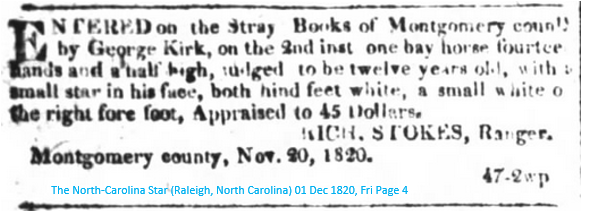
Moving on to Newspapers, I found that in Nov 1820, George Kirk found a stray horse of which he entered in the Stray Book of Montgomery County. A description of the horse can be found in the Newspaper ad submitted by Richard Stokes, Ranger.


Dr. Francis Kron, who also lived in the area of Montgomery that became Stanly County in 1841, offers insight about his near neighbors and the lives that they lived. In his journal, dated 1835, he writes that he lived about a mile west from the Yadkin River. Dr. Kron personally knew the Kirk family and was personal physician to many of them. Dr. Kron tells us that between his home and the river stood the Kirk Inn and that after George Kirk died, his wife, Francis Bell Kirk, (called Frankie), continued to operate the Kirk Inn.

That area today, is overgrown and lush, with only a hint that life was once abundant here. The Kirk Inn undoubtedly sat on the hill that rises above the river, an old roadbed cut into the land by the wagons that brought passengers from the Kirk Ferry to the Kirk Inn.

George's brother, Alexander, inherited from John Kirk Esq, their father, what is now known as the old Lowder Ferry, located below the junction of the Uwharrie and Yadkin Rivers, where the Yadkin becomes the Pee Dee River. Dr. Francis Kron, in his journal, referred to a ferry one mile from his home as Kirk's Ferry. In 1830, Alexander Kirk sold the ferry to his brother, George Kirk, who operated it until his death in 1845. Between 1860-1870, George Kirk’s heirs sold the ferry and the land to David Lowder.


According to “Stanly County USA: THE STORY OF AN AREA AND AN ERA (1841-1991), the Kirk Inn was a two-story building that contained 16 rooms with a wood stove in each room.”

“The plantation we live is on the west side of the Yadkin, a mile from Kirk's Ferry the same distance south of the great falls on the market road from Salisbury to Fayetteville.” Dr. Francis Kron’s journal.

“A modern Madeleine was taken in the evening with most violent symptoms of hysteria. Mrs. (widow) Kirk, who was delivered of a posthume two years after the death of her husband, is the penitent to whose aid I was called. She talked most lamentably of her faults, the disgrace of her children, her sorrow and desire for forgiveness and mercy. She is at last in a way to recover from her spasms and menial mania.” Dr. Francis Kron’s journal.

“From my house to within a mile of patient's I traveled on the Salisbury Turn-Pike. It either crosses incessantly the numerous ridges that expire on the edge of the Yadkin or follows the bed of some branch through narrow stony gaps. On that whole road there are but two plantations with tenants; two worn out and abandoned and another in a way of clearing to be abandoned at some future day. The first inhabited plantation about a mile from my house, where one Michael Fesperman, a millwright and ingenious mechanician lives.” Dr. Francis Kron’s journal.

“On returning home met with Mr. Carter of Rowan County a former member of the legislature whom, it being dark and he unacquainted with the road, I conducted to G. Kirk's for traveling accommodations.” Dr. Francis Kron’s journal.

In 1846, the Carolina Watchman, a Newspaper in Salisbury, North Carolina, paid a Tribute of Respect to John Giles Esq, late of Salisbury, who had died at the home of Mrs. George Kirk in Stanly County while on his way from Lawrenceville (Montgomery County) to Albemarle (Stanly County). The article does not say how he died, but in 1846, the only way to get from Lawrenceville to Albemarle was by way of ferry across the river.


Kirk’s Ferry is found in multiple old Newspapers from as far back as 1816, three years before John Kirk Esq, the father of George Kirk, died. It must have been a landmark, known by all in the counties of Montgomery and Stanly and even Rowan. James Mask and Alfred Dockery, when advertising land for sale, made sure to mention that said land was close to Kirk’s Ferry, location, location, location!

Another article, dated 1848, made note that Kirk’s books showed the average for both ways per year was 400 wagon crossings, 750 horseman and 40 to 50 light carts and wagons.

In 1883, Dr Kron’s obituary noted he died at his home near Kirk’s Ferry.

In 1884, news of the storm that destroyed David Lowder’s fine two-story dwelling that was erected at the old Kirk Ferry, at the mouth of the Uwharrie River, was reported from Charlotte.


In 1887, Capt. W.H. Bixby and Lieut. Taylor of the U.S. Engineers, took an adventurous journey down the Yadkin and Pee Dee Rivers in what was reported as a small flat-bottomed skiff with two oars. They put in 40 miles above Salisbury. The trip was to make an examination of the Pee Dee with reference to improvement of the navigation of the river. The gentlemen were to paddle 150 miles down river to Cheraw, South Carolina.

The first day, the party made 57 miles with but little difficulty. The second day they made but 14 miles due the tumbling falls and rapids of the river. They had gone but 3 miles when the boat struck a rock which made a 3-foot-long crack in one side, a quarter inch wide, plunging down a 4-foot fall, and came to rest on a rock. Repairs were made to the boat and the journey continued only to encounter larger, 8 foot falls and currents so swift that the boat was swept along at speeds of more than 20 miles per hour causing the boat to upset and drop its passengers and all their belongings into the river.

Upon pulling the boat to shore and collecting what belongings they could, two of the men decided to make a reconnaissance on foot down the river. They found a fall over which it would have been impossible to pass over in the boat. The article seems to suggest that the men carried the boat between them down the river and over the rocks, past the dangerous falls. About a mile further, the men hauled the boat out of the river again and carried it some 5 miles around the Narrows until finally coming to stop for the day at Mr. Lowder’s, at Kirk’s Ferry.


George Kirk died in 1845 and is said to be buried in the Kron graveyard. His wife, Francis Bell Kirk, called Frankie, lived until Nov 1869, when her name is found on the U.S. Federal Census Mortality Schedules, 1850-1885 as dying from Typhoid Fever.

Friday, June 19, 2020

Paulina Mary 'Polly' Kirk Moss

The third person mentioned in the division of land in the John Kirk Dec’d estate file is Polly Moss.

Division the 3rd Lot No 6 valuation $561 to Polly Moss. Lying on both sides of Ryals Creek beginning at a pine by two pines the beginning corner of a hundred acre survey and runs with a line of lot No 5 south west one hundred and thirty two poles to a dogwood by a dogwood the corner of lot No 7 thence with a line of said lot south thirty nine east one hundred and eighty two poles to a maple by a willow oak thence east 54 poles to an ash by two ash pointers in a swamp thence north 30 west 114 poles to a stake between a hickory and red oak pointers thence east 121 poles to a pine thence north 127 poles to a hickory by a sweet gum thence west 127 poles to the beginning. Containing one hundred and eighty-seven acres.


At her father, John Kirk’s, death, Polly inherited 187 acres of land on both sides of Ryals Creek that adjoined her brother’s Parham (Lot No 5) and Lewis (Lot No 7).


Polly Kirk was born about 1793 in Montgomery County, North Carolina, in those parts that later became Stanly County. She shows up on the 1800 Census for Montgomery County in the home of her father, John Kirk. She has 9 siblings, 4 brothers under the age of 10, 1 brother between the ages of 10-15, 2 brothers ages 16-25, a sister under the age of 10, 2 sisters between the ages of 10-15.


In 1810, John Kirk is listed with 4 daughters living in his home. Polly is most likely one of the 2 daughters listed between the ages of 16-25.


I know, based on the date of John Kirk’s estate file, that he died about 1818/19 and Polly was named as Polly Moss in that file, so she married after 6 August 1810, the official enumeration day of the 1810 census. Known son, Edward Moss, was born about 1816, so I can conclude that Mary Kirk married about 1816 at the age of 23.

On 14 Nov 1834, Dr. Francis Kron noted in his journal that he had a visit from his immediate neighbor, Mrs. Paulina Moss, who was a living widow, being separated from her maniacal husband. I am not sure if this indicates that her husband is still living, but Polly is, indeed, separated from him either by choice or by death. Dr. Kron notes that Polly lives with her brother, James Kirk, who is about 36 years of age and not married. Dr. Kron also notes that Polly is a virtuous, active, amiable woman with much prudence.


Back tracking to the 1830 Census, Polly Moss and her son can be found living with her brother, James Kirk. So, she has been a widow or separated from her husband since at least 1830.


Dr. Francis Kron lived in what is current day Morrow Mountain State Park in Stanly County, North Carolina. Historical records tell us that this area was not, in what most think, the backwoods. I would venture to say that the area is more backwoods in current times than it was in the 1830s. On the contrary, Dr. Kron lived in a prosperous area, on a (then) main road and had many neighbors, among them, Fesperman, Moss, and Kirk, whom like himself were considered hardworking and prosperous families.


On the first day of Dec 1835, Polly sells to Conrad Miller of Rowan County, 23-acres of land that she inherited from her father, John Kirk, when he died in 1818. The deed states that this land was originally part of a 100-acre survey granted to James Morey and the survey showed it began at a stake on the west side and at the old Ford of said (Ryals) creek.


James Morey has two grants but only one shows issued, No 5382. That survey, done in July 1801, is for 100-acres of land on Ryals creek joining the widow Weeks, Fisher and Kirk’s land on the Salisbury road. The chain carriers were David Stillwell and Russell Freeman. At some point between 1804 and 1818, John Kirk perhaps purchased all, or at least part of, this land from James Morey. I found what might be a possible James Morey on the 1790 and 1800 Census of Montgomery County, but he seems to disappear after that. Since deed records for Montgomery were mostly destroyed, I am not able to confirm that John Kirk purchased this land from James Morey or from some other person that James Morey may have sold it to.


Conrad Miller, whom Polly Moss sold the land to, is the son of Jacob Miller, a man of German descent who hales back to LT Johann Wendel Miller who arrived in Pennsylvania in the 1730s. In 1753, a Land Grant is issued to Wendel Miller in Rowan County, North Carolina. He is one of the earliest settlers in Rowan County, and at the age of 22 takes a Native American to live as his common-law wife. She was called "Indian Lady" and given the Christian name Elizabeth (courtesy of Find-A-Grave).

Conrad Miller married Susana Lentz, the daughter of Johann Dewalt “David” Lentz, who is also of German descent, born in Berks County, Pennsylvania and made his way to Rowan County with the tens of thousands of German and Scotch-Irish immigrants who entered the colony from the north along the Great Wagon Road and settled in the western Piedmont of North Carolina. The Moravian settlements of Bethabara, Bethania, and Salem, as well as the cities of Salisbury (Rowan County) and Charlotte (Mecklenburg County), owe their creation and expansion to the Great Wagon Road (https://www.ncpedia.org/great-wagon-road).


After 1835 things get a bit tricky in the research of Polly Kirk Moss. I feel certain that she had at least one child, a son, and they are most likely the same as listed in the household of James Kirk in 1830. Most research suggests that Edward Moss, married Christina Barringer, is the son of Thomas and Polly Kirk Moss. My research has not found any documented evidence to this theory. I have not found any to disprove it either.

There is some research done by David Kirk Shaver Sr found on Ancestry and attached to many family trees that seems to indicate that enough research has been done on this family to at least conclude that Edward Moss is the son of Thomas and Polly Kirk Moss.


It is through two children of Edward Moss, Ellen and John, that I currently can claim a family tie back to the Kirk Family. Ellen Moss married Stokes Allen Earnhardt and my Morris line, in much later years married into the Earnhardt family. John Moss married Julia Misenheimer, whose line reaches back to my own maternal Misenheimer line from Cabarrus and Rowan Counties. The grandchildren of Edward Moss will marry into my Dennis line via way of Ragsdale and the great grandchildren of Edward Moss will marry into my Fesperman line.

If anyone out there does have documented proof that Edward Moss is the son of Polly Kirk Moss, please reach out to me through this Blog.