Monday, February 1, 2021

Finds at the Archives

It is amazing what you can find by digging through other people’s stuff, and how, like a set of fallen Dominos, things can just fall into place! There is no such thing as researching just one direct family line. If one hopes to find information on their direct family line, one must research the entire county, especially when records have been destroyed or are missing as that is the only way to piece families together – by record association. 

On a recent trip to the North Carolina State Archives, I found the collection of W. K. Littleton, consisting of 9 folders and the J.R. Coggins collection on microfilm. The collections were donated to the archives by heirs of the Bell and Coggins families. All the folders are full of historical documents on the families of Montgomery County, North Carolina. So, a big Thank You to those family members who decided to share these collections. And a BIGGER THANK YOU to the living heir who gave me permission to make copies of the J. R. Coggins collection – you know who you are! 

Below are a few of the finds that prompted me to order copies from both collections.

Eliza Bell, whom I can only assume is Elizabeth Ledbetter Bell, the wife of Benjamin Bell, made purchases at Hardy Morgan's store between 1826 – 1828. Elizabeth is the daughter of Charles Ledbetter.While researching Charles Ledbetter, I found an early deed, dated 1792, between him and Nathaniel Edwards for land on Island Creek. I had been looking for documentation to prove Nathaniel Edwards was the son of John Edwards, and I found it in this deed that states Nathaniel is the son of John. I am still looking for documentation that might link Elizabeth Edwards to Nathaniel and John Edwards. Elizabeth married first Brantley Harris and second, Arthur Harris, the brother of West Harris. Elizabeth’s sister, Edith, married West Harris. Such a tangled web!

Family Search: Montgomery. Deed Records 1774–1795, Deed Records 1798–1807, Deed Records 1838–1847I’ve wrote a great deal on Hardy Morgan in previous blogs. I believe Hardy may be the brother of my fourth great grandfather, Joseph Morgan. Hardy owned a store in what is now Uwharrie, Montgomery County, North Carolina, called Morgan’s store. The above document was prepared by Hardy and looks to be from his store ledger. Hardy and his family moved to Pontotoc County, Mississippi in the 1840s and after his death in 1854, his wife and several children moved on to Arkansas.

I believe Hardy is the son of Charles Morgan who migrated from Chatham County, North Carolina to Montgomery County, North Carolina about 1805. I do not know who his wife is. She looks to have died before the family left Chatham. Hardy’s wife, Nancy, is another person I am also seeking information on. She declared in her War of 1812 widow’s pension that her maiden name is Hearne. Most researchers have her mixed up with Nancy Hearne, the daughter of Ebenezer Hearne and Dovey Walker, who married Clayton Steed and lived her life in Randolph County, North Carolina. I wrote about that in another Blog.

In another document found at the archives, I learned that Selby Hearne and Isham Coggin turn up with Hardy Morgan in some deeds (see below) and, as most researchers know, whenever two or more names are seen together multiple times, it can lead to some valuable clues that can solve a puzzle. The puzzle I am hoping to solve is who the parents are of Nancy Hearne Morgan.

I have been looking for the following deed since September 2018 when I wrote the Blog E.F. Morgan.

In that Blog I wrote, “On the 2nd day of March 1840, E.F. Morgan, of the county of Montgomery, sold to John Hall, of the county of Randolph, for the sum of $725, and lying on the east bank of Barnes Creek, land that included a Grist Mill and a Sawmill. Two other tracts of land, known to many as the McCulloch tract and Spencer tract, sold to John Hall at this same time.

At the end of the deed the following was added, “the sd E.F. Morgan doth hereby by these presents exempt one acre & a half of the McColloch Tract of land to begin at McColloch’s last corner on Uwharrie River adjoining the lands of sd George Coggin as the same heretofore has been sold to sd Coggin by Hardy Morgan.” The deed witnessed by H. (Hardy) Morgan and A.H. Sanders, proven by oath in open court by A.H. Sanders. That raises the question if E.F. and Hardy Morgan owned this land jointly or if E.F. Morgan had bought the land from Hardy Morgan at some time in the past and they all forgot the one-acre and a half had previously sold to George Coggin until the land sold to John Hall.”

Found among the J.R. Coggin Papers 1813-1868 (File number MIP.7) at the North Carolina State Archives is the deed where Hardy Morgan sold the 1 acre to George Coggins.

This Indenture made the 10th day of October AD 1835 Between Hardy Morgan of the county of Montgomery and state of North Carolina of the one part and George Coggin of the county and state afore sd of the other part witnesseth that for and in consideration of the sum of fifteen dollars to the sd Hardy Morgan in hand paid by the sd George Coggin the receipt whereof is hereby acknowledged and the sd Hardy Morgan doth herby bargain sell and deliver unto the sd George Coggin by these presents a certain tract or parcel of land containing one acre and a half situate lying and being in the county & state afore sd and on the No Et bank of the Uwharrie River adjoining the lands of the sd Coggin being the upper corner of the McColloch tract Beginning on a mulberry stump standing on the No Et bank of sd river … above the mouth of the sd Coggin spring branch and runs … to a sweet gum sapling stands in sd line amongst some dogwood(?) then a So. Wt. course a long a slope (?) & line to a bunch of Burch bushes standing on the bank of sd river amongst a hickory & walnut pointer … to the beginning corner

The same to have and to hold and to be to the proper use of the sd Coggin him and his heirs and assigns forever and him the sd Hardy Morgan doth by these presents for ever warrant and defend the right and title of the sd tract or parcel of land hereby conveyed to the sd Coggin against all lawful claim or claims of any person or persons (?) in witness where of the sd hardy Morgan doth hereunto set his hand and seal the day and year first above written. 

H. Morgan Seal

Signed sealed and delivered in the presents of

Selby Hearn

Isham CogginIn another document I found digging around at the archives, Benjamin Bell signs as security for Jesse Dennis who rented the Dutch John Plantation in 1817 from William Brookshire. Jesse Dennis is the son of Andrew Dennis, my fourth great grandfather. Jesse married Frances Blalock, daughter of William David Blalock Senior. Frances’s brother, William David Blalock Jr., married Jesse’s sister, Martha. I believe the Blalock and Morgan families knew one another from Chatham County and probably came to Montgomery County together in the early 1800s.

Jesse had a land grant for 640 acres of land in Montgomery County in the fork of the Yadkin and Uwharrie Rivers beginning on Brookshire's line (probably the same William Brookshire who owned the Dutch John Plantation) ... and running .... near the new road ... dated 4 Dec 1819. Two of Jesse's horses are named in the deed, Hercules, a bay gelding and Borus, a stud horse. Jesse died between the 1830 and 1840 Census years. I have yet to discover what happened to the 640 acres of land he owned. I am also curious to know who William Brookshire is, so more research to be done on that name.In January 1820, Benjamin Bell Senior paid one dollar, the full amount of his account owing at Hardy Morgan’s store. Hardy Morgan also received of Benjamin Bell Senior fourteen dollars in part of a note given by said Littleton Harris, Hardy Morgan, and Sally G. Harris Executors to Turner Harris Deceased. Turner Harris is another name that I am working on, so this find was of great value to me. Turner Harris of Montgomery County who married Susannah Thomas has been confused with the Turner Harris from Davidson County who married Elizabeth Rush.

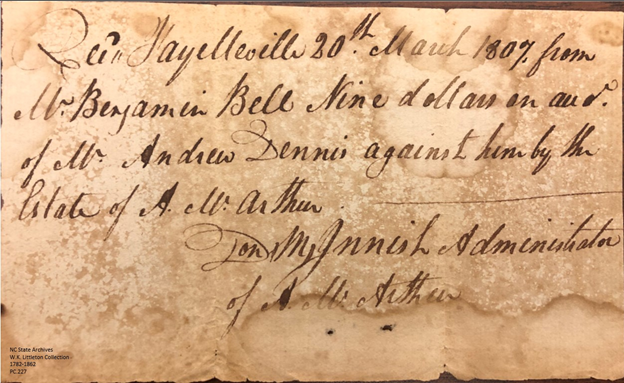
I do not know who Sally G. Harris is mentioned in the below receipt but would almost bet that she is probably his second wife as Susannah Thomas Harris, his first wife, died in 1799. It is obvious by this receipt that Turner Harris is dead by 31 Jan 1820 as he is mentioned as “Dest” (deceased).The below paper has brought about a ton of confusion for me. It looks to read, “Rec’d Fayetteville 20th March 1807 from Mr. Benjamin Bell Nine dollars on aud. of Mr. Andrew Dennis against him by the estate of A. McArthur. Don McInnish Administrator of A. McArthur”

When I first read this paper, I thought A. McArthur may have been related to Nancy McArthur who married Charles Bell, the son of Benjamin Bell, whom the receipt is made out to. However, upon finding Don McInnish had a store in Fayetteville, (he died in 1811 leaving an estate file that can be found on Family Search in Cumberland County) I am now questioning if Benjamin Bell was the administrator of the estate of Andrew Dennis. 

However, Andrew Dennis did not die until after 1830 (he is listed on the 1830 Census for Montgomery as older than 90 years). But why would Benjamin Bell pay a $9 bill for Andrew Dennis against the estate of A. McArthur?

And who is A. McArthur?

More research required here!

I am totally confused over this one and have enlisted the help of some family members to help sort this out.

If you have another interpretation of the below, please post it in the comments section.Now, here is a new name to add to my file: Timothy Lax sold land to George Coggin and he may be the same man who is later found in Hardeman County, Tennessee by the same name. Who is he and what connection does he have to George Coggin? He is found on the 1830 Census living east of the Pee Dee and Yadkin River between Wiley Chappell and Leonard Graves.
Hardy Morgan and his son, Ebenezer Franklin Morgan, signed as witness.The deed is translated as follows:

This indenture the 26th day of January in the year of our Lord one thousand eight hundred and thirty three between Timothy Lax (note: there was a Lax family in Randolph County and I wonder if Timothy may be related?) of the state of North Carolina and county of Montgomery of the one part and George Coggin and the county and state aforesaid of the other part witnesseth that for and in consideration of the sum of seventy five dollars to him the said Timothy Lax in hand paid by the said George Coggin at or before signing and delivering of these presents the receipt whereof is hereby fully acknowledged have bargained sold and delivered and by these presents doth bargain sell and deliver unto the said George Coggin his heirs and assigns forever a certain tract or parcel of land lying and being situate in the county of Montgomery and state of North Carolina and lying on the east side of the Uwharrie River and on the west side of Barnes Creek and being part of a survey of two hundred acres surveyed for Mark Bennett in 1779 as showeth on Bennett’s plat beginning at a pine a line tree of the said George Coggin formally Agrippa A Steed's and a corner tree of Jesse Clifton and runs thence south with the said Coggins ? line and Selby Hearn's line to a stake standing between Selby Hearne’s house and spring thence east ninety three poles to another stake the said Coggins line of his Clemmons tract near the house thence south west the said Coggin line of his Clemmons tract to a branch running southward to Barnes Creek then running the various courses of the said branch to the said Bennett’s old line which is equal to one hundred and seventy nine poles direct from the corner at the Clemmons place thence west one hundred and twenty poles to the beginning containing one hundred acres the same being more or less and all and ? and every the ? to the same belonging on in any wise appertaining to have and to hold the land hereby conveyed and singular ....

Timothy Lacks (his X mark) 

Signed and sealed and delivered in the presence of 

H. Morgan 

E. F. Morgan

Monday, January 18, 2021

Coming to America - the other Malcom Chisholm

Malcom’s story begins near Minginish, a peninsula on the island of Skye, Dunvegan, North Britain (Scotland) on 30th Sept 1790 when Roderick Chisholm wrote a letter addressed to “Dear Sir” asking for help for “poor Malcom.” Who the “Dear Sir” is exactly is in question. But suffice it to say that the letter must have reached its intended as “poor Malcom," as later records show, received the help that Roderick Chisholm asked for.
To understand Malcom’s plight, we must look back in time, because Malcom, like all our ancestors, lived in a period known only to us as history. The Highland Clearances, as it became known, was not a new thing in 1790, nor could it have been new to Malcom who is believed to have been born about 1767. He would have been born during a time when Scottish citizens were fleeing Scotland in droves and the Highland Clearances were at a height. By 1790, he may have also been looking for a better life for himself and his family. 

In the terrible aftermath of the battle of Culloden in 1746, Highlanders, driven by famine and poverty, emigrated in the thousands to the colonies of America; some to Canada and Australia. During the first stages of the Highland Clearances, from 1760 to 1800, estimates suggest that over 70,000 Highlanders and Islanders emigrated. Scottish emigration was not made in steady flows, but rather, it was concentrated in four periods: 1770-1775, 1790-1793, 1801-1803, and 1805-1811. 

Strathglass, known in Gaelic as Crom ghleann, is the area around Upper Valley of the River Beauly, about 10 miles west of the city of Inverness. The area here belonged to the Chisholm Clan who strongly adhered to the Catholic faith, spoke Gaelic, and, like all Highlanders, had strong connections to the land and their belief system.It wasn’t until 1801 that the clearances reached Clan Chisholm; with nearly 50% evicted in the Strathglass area by William, the 24th Chisholm, within a year of his attaining the Chisholm seat upon the death of his brother, Alexander, who had no sons. Most evicted tenants removed to Canada and Nova Scotia. After William’s death, his wife, Elizabeth, continued with the clearances and once grown, his son, Alexander, the 25th Chisholm, continued eviting people to make way for sheep. 

In contrast, Chief Alexander, the 23rd Chisholm, with the support of Elizabeth, his wife, and their only daughter Mary, resisted pressure to clear their land of clansmen and lease Chisholm lands to southern sheep farmers. When chief Alexander died in 1793, just 3 years after Malcom left for America, the widow Elizabeth, who had been left several crofting settlements by Alexander, her husband, kept the tenantry of those crofting settlements intact for 33 years, never turning anyone off their land. 

So, it is with wonder and uncertainty that I must try to rationalize why Malcom decided to leave Scotland in 1790, when at that time, no Chisholm was turned off clan lands. Perhaps Malcom “saw the writing on the wall” and knew that at the death of his Chief, Alexander, the new Chief, William would not hold true to former promises? Or perhaps, Malcom had just made some bad decisions for himself and gotten into some trouble and needed an escape route? Or perhaps Malcom had just fallen on hard times and was looking for a better life? Or perhaps, the Chisholm line who lived in Dunvegan, Isle of Skye, are not related to the Chisholm’s who lived in Strathglass and therefore, were not protected? 

The letter states that it is of “necessity” that Malcom must go to America so I cannot logically assume here that Malcom just wants some adventure in his life and wants to travel to the American colonies for the fun of it. The letter indicates that Malcom has a wife, Margaret, and a family, so at least a child or possibly more will be traveling with him and Margaret. The letter also indicates that Malcom is the nephew to “Dear Sir” whom the letter is addressed to. 

I may never know why Malcom came to America but what I do know about Malcom is that he did make it to America and that current-day genealogist have him terribly confused with Malcom, son of Murdock who died prior to the 1823 probate date of Murdock’s estate. 

Malcom Chisholm who came to America in 1790 lived until 1844 and he left an estate. That file is dated Jan 1844 and begins… 

In the name of God .. Amen 

I Malcom Chisholm for the county of Montgomery and state of North Carolina being sick in body but in my common good sense and sound memory doth this the 3rd of January 1844 make and publish this my last will and testament in way and manner following that is to say 

First, I give and bequeath to my wife Flora Chisholm the tract of land on the west side of mountain creek whereon I live during her lifetime and after her death to my two daughters Nancy Chisholm and Catharine Chisholm also all of my stock to stay together until my son John Chisholm comes of age 

Second, I give and bequeath to my two sons Kenneth Chisholm and John Chisholm all of my land that lies on the east side of mountain creek to be equally divided between them when my son John Chisholm comes of age My will further is that give to my son Daniel A Chisholm two dollars and also to my three sons Angus C. Chisholm Murdoch Chisholm and Malcom Chisholm Jr fifty dollars each. 

To my daughters Carthen McKinnon fifty dollars and to the heirs of Christian Gillis’ body fifty 

Thirdly (?) will is that my son John John Chisholm will have fifty dollars a year for three years and three months schooling 

His 

Malcom X Chisholm 

Mark 

Sealed and signed by the testator in the presence of us John Ewing Kenneth McLendon 

Codicil to the forgoing will 

State of North Carolina 

Montgomery County 

Whereas Kenneth McLendon this day appeared me Malcom Murchison one of the acting Justices of the peace in and for said county and make oath in due firm of law that on the third of this Instant Malcom Chisholm of said county and state in his last will & testament did give and bequeath to his wife Flora Chisholm a negro man named March her life time which said negro March was forgotten to be inserted in the last will and testament of said Malcom Chisholm sworn to & subscribed before me the 6th January 1844. Kenneth McLennan 

Malcom Murchison JP 

Montgomery County Court April Session 1844 Then the execution of this will was duly proven in open court by the oath of Kenneth McLennan one of the subscribing witnesses and ordered to be recorded.From the will we learn that Malcom is married to a woman named Flora. Margaret who was mentioned in the letter must have died and Flora is the second wife. Ten children are also named in the will. Two of his daughters are unmarried as he lists them as Nancy Chisholm and Catherine Chisholm (later married Norman McDuffie). Two daughters are married, Carthen (in later records mentioned as Catherine) McKinnon and Christian Gillis, who looks to have died as Malcom leaves her share to the heirs of her body. Six more sons are named in the will, John, Kenneth, Daniel, Angus, Murdoch, and Malcom Jr. 

Let me stop here and provide some background and timeline information. 

There were two Malcom Chisholm’s. Both were born in Scotland, probably Isle of Skye, and both were born about the same time. Malcom (b. 1763), the son of Murdock, left Scotland with his parents and siblings and arrived in North Carolina before 1780, his sister, Rachel, married James McMillan about 1780/1. Read more about that Malcom here.

Malcom (b. 1767), the subject of this Blog, left Scotland after 30 Sep 1790 (the date of the letter) and sailed to America. He probably arrived 3 to 4 weeks later either at the port of Wilmington, North Carolina or a port in South Carolina. He would have made his way up the Cape Fear River, if coming from Wilmington, or the Pee Dee River, if coming from South Carolina. That trip would have taken several more weeks. So, he most likely arrived in Montgomery County, North Carolina around or after Jan 1791. 

The letter indicates that Malcom is married to Margret and has a fine family who can be of service to whoever the “Dear Sir” is that the letter is addressed to. The fact that Malcom settled within 2 miles of Murdock Chisholm and the letter indicating that Malcom is the nephew of “Dear Sir” would indicate that Malcom’s father, who remained in Scotland, is the brother of Murdock. Who Roderick Chisholm is will remain a mystery for now, but we know from the letter that Roderick knew who Murdock was and most likely had been in communication with Murdock several times. Roderick is not the brother of Murdock as the letter plainly states more than once that Roderick and “Dear Sir” have never met. 

Later records for the children listed in Malcom’s 1844 estate file indicate that these children were born between 1806 and 1825. We know that Margaret is the wife of Malcom as the letter tells us that. We know that Flora is the wife of Malcom as his estate file tells us that. What happened to Margret and the family mentioned in the letter is unknown to me, but I find it a bit odd and unexplainable that Malcom and Margret left Scotland in 1790 with a family in tow but had no other children until 1806 – 16 years after they arrived in America. So, either the birth dates of the children are way off in the records, or Flora is the mother of all the children listed in Malcom’s estate file, which would be odd in and of itself as there were two children named Catherine. Although Malcom makes a distinction between his two daughters in his will by calling one Cathern and the other Catherine. However, in later records, both are listed as Catherine. 

I do not believe that Margret and the children perished at sea and Malcom arrived in North Carolina alone and did not remarry until 1805/6. Again, that theory does not explain why Malcom has two daughters named Catherine. 

Angus C. Chisholm’s estate file provides the most information about the children of Malcom. 

State of North Carolina Court of Pleas & Quarter Sessions 

Montgomery County Jany. Term 1860 

To the worshipful the justices of said court The petition of Flora Chisholm, John C. McKinnon & wife Catharine, Angus Gillis & wife Christian, Nancy Chisholm, Norman McDuffie & wife Catherine, John Chisholm, Malcom A. Chisholm & the heirs of Murdock Chisholm, Dec'd. against Kenneth Chisholm, Adm of Angus Chisholm respectfully showeth unto your worships that Angus Chisholm, who is their brother, died intestate leaving your petitioners & the defendant his only heirs & distributees.Angus’s estate file tells us that Daniel A. Chisholm who was listed in Malcom’s 1844 will is dead by 1860, the probate date of Angus’s estate. Daniel, nor any heirs, are alluded to. Angus’s estate file also tells us that his brother Murdock is dead as it lists the “heirs of Murdock Chisholm Dec’d” but unfortunately does not name his wife or children. We also know from the file that Nancy Chisholm looks to have never married as she is listed by her surname, Chisholm. Flora Chisholm, mother of some or all of the children is still living in 1860. 

The eldest Catherine married John C. McKinnon. She is mentioned as Cathern McKinnon in Malcom’s 1844 will. They had children John Chalmers (1854), Christian (1855), Daniel (1859), Malcom (1860), Flora (1862), Cornelia (1865). 

Christian, who was listed as Christian Gillis in Malcom’s 1844 estate and indicated as dead, the estate file gives $50 to the heirs of her body, looks to be alive in Angus’s 1860 estate file. She married Angus Gillis. 

John Chisholm married Nancy Watson and they had John (1859), Flora (1862), Sarah (1865) and Malcom (1867). 

Kenneth C. Chisholm married first Christian McLennan. They became the parents of Thomas Little (1851), Mary (1852), Isabelle (1854), Sarah (1855), Allen (1859), John (1866), and possibly a daughter named Flora that I have not been able to confirm yet. Kenneth married second Abigail Harris Rush and it is through his marriage license that he is the only child that I can confirm his mother, FloraMalcom Chisholm Jr, as he is listed in the 1844 estate file of Malcom, led perhaps the most interesting life and records left to us by history have led me on a merry chase and offered some great clues on how the Chisholm family may have interacted with some prominent families of Anson, Richmond, and Montgomery counties. 

By 1850, Malcom is found in Montgomery, Alabama living with a man named Thomas Holt, a Merchant born in Virginia. Malcom’s trade is listed as a cotton broker and he works in the Industry of Farm Products--Raw Materials. He is hired to sell cotton or other crops for a plantation owner and probably has a host of other job duties as well. His young wife, Cornelia, was born in Connecticut. 

Of interest, on the next page of the Census is listed Liman Scovell, age 46 (old enough to be Cornelia’s father), a grocer worth $3,000 who is also born in Connecticut.In 1856, Malcom provides a Power of Attorney to his brother, Kenneth, to act as his agent to collect the amount of legacy coming to him from his father, Malcom’s, estate which was in the possession of John Ewing who Administered the estate.In a somewhat unusual twist of fate, by 1873, Malcom is the owner of a country farm that was previously a large plantation owned by Colonel A. J. Pickett. 

According to the website Alabama Pioneers, Colonel Albert J. Pickett was born on August 13, 1810, in Anson County, North Carolina to William Raiford Pickett and Frances (Dickson) Pickett. William Raiford Pickett was sheriff of Anson County North Carolina. Around 1816, he resigned his position and went with his first cousin Tod Robinson to Alabama and bought property. 

Let me take a moment to add some background: Tod Robinson is the son of Cornelius Robinson and Elizabeth Pickett Robinson of Anson County. He is the nephew of Charles Robinson, who was an allied family that had close ties to the Murdock Chisholm family through marriage. Arthur Robinson’s (son of Charles) sister-in-law, Elizabeth Stanback, intermarried with John Chisholm, the brother of Mary Chisholm who married John Morrison

Read about Tod Robinson here.

There are many Colonial records that remain on the Robinson family. Find them here.

Alabama Pioneers continues to say that by 1819, the Pickett family moved to “Cedar Grove” plantation near Autaugaville, Autauga County, Alabama. There they established a plantation trading- house (where Brokers like Malcom worked) and engaged actively in the Indian trade, especially with the Creeks. 

At the age of 18, Albert was sent to a military academy in Middletown, Connecticut. In 1828, Albert reached Wadesboro, (Anson County) North Carolina safely after traveling on horseback from home. There he exchanged his saddle bags for a trunk, sold his horse and continued his trip to Connecticut by stagecoach.The Malcom Chisholm home today is owned by the Montgomery County, Alabama Historical Society.By 1880, Malcom and Cornelia Caroline Chisholm are found in Elam, Montgomery, Alabama with four sons, Charles, John, Malcom, and William. Notice that Malcom claims he was born in Scotland, this is not true, he was born in North Carolina. His age is 70 years, making him born about 1810. According to the 1850 Census, he was born about 1815 in North Carolina, which is more in line with previous records and events in his life.In 1881, Malcom, who had not been home in 50 years, visits his family in North Carolina.Malcom died in 1893 and was laid to rest in Oakwood Cemetery in Montgomery County, Alabama. You can view his memorial on Find-A-Grave here.

Sunday, December 27, 2020

John Chisholm, son of Murdock

John Chisholm is the son of Murdock and Mary Chisholm. He was born about 1776 in Scotland. He came to America with his parents and siblings before 1780, most likely following the path that many Scots did, arriving in Wilmington, North Carolina and making their way up the Cape Fear River to Cross Creek, now Fayetteville, and then migrating to Richmond County and later to Montgomery County. 

John married Elizabeth Stanback, daughter of Thomas and Mary Jennings Stanback, a prominent family in the area. Elizabeth died 20 Jul 1817 and John, shortly after, in Oct 1818. Both are buried on Luther Mountain, just west of Harrisville, Montgomery County, North Carolina.

Find-a-grave shows six people with the surname Chisholm buried on Luther Mountain. 

Adaline Chisholm: 10 Mar 1815 - 23 Jan 1816 

Elizabeth Chisholm: unknown - 20 Jul 1817 

John Chisholm: unknown - 10 Oct 1818 (Inscription: Aged 42 yrs.) 

John Chisholm: 1776 - 8 Mar 1805 (Find-A-Grave mistake - there is no grave for this John Chisholm on Luther Mountain)

M. P. Chisholm: 1815 - unknown 

S. P. Chisholm: unknown – 1818 

Also buried on Luther Mountain are those with surnames Jennings, Horne, Luther, Poole, Powell, Smith 

Adaline Chisholm was 10 months old when she died and could possibly be the child of John and Elizabeth who died young. M.P. Chisholm and S.P. Chisholm may have also been children at the time of their deaths. I have not been to this cemetery yet but hope to at some future date. I am told by those who have visited this cemetery that John Chisholm (age 42) is buried next to Elizabeth Chisholm.

Based on the dates of death, 1816 – 1818, most of these people probably died of some epidemic that was ravaging through the area at that time. In a Newspaper article published in the Weekly Raleigh Register, Raleigh, North Carolina, 10 May 1816, is found the obituary of Ralph Gorrell Esq, who died “of the prevailing Epidemic.” In years to come, the daughter of John and Elizabeth Stanback Chisholm, will marry the grandson of Ralph Gorrell Esq.

John and Elizabeth Stanback Chisholm had two children, Calvin J., and Mary Jennings Chisholm. In the 1818 Richmond County estate file, found at Family Search, of Thomas Stanback is found the documented proof to show that the children of John Chisholm are heirs-at-law of Thomas Stanback. The file states, “to Calvin Chisholm & Mary Chisholm infant children of John Chisholm Dec’d”
Later in the file, at the time of distribution, we find out that Anguish (Angus) Chisholm, the brother of John Chisholm Dec’d, is the guardian of Calvin Chisholm and Mary Chisholm.
Richmond County, North Carolina Court of Pleas & Quarter Sessions June Term 1818, Mary Morehead Stanback, second wife of Thomas Stanback, petitions the court for her dower. In this document can be found further proof that Elizabeth (called Betzy / Betsey) is the daughter of Thomas Stanback, that she married John Chisholm, who is now dead, and that Calvin Chisholm and Mary Chisholm are her children and the grand children of Thomas Stanback.
Thomas Stanback is probably best known for his purchase of Mask’s Ferry. At the March Term of Court in 1781 it was ordered that Thomas Stanback would maintain a tavern at Mask’s Ferry. Legend has it that from that time onward, Mask’s Ferry became known as Stanback’s Ferry, until it closed about 1928.
However, of interest, Mask’s Ferry still looked to be in operation in 1811 and was still known as Mask’s Ferry, as it is noted in a newspaper article “Roads from McFarland’s Turnpike” in the Weekly Raleigh Register.
Thomas Stanback married first Mary Jennings, daughter of John Jennings and Lydia Batts. According to a Newspaper article from 1931, most North Carolina Jennings claim descent through Colonel John Jennings who came from Virginia to Anson County, North Carolina about the year 1774. Mary Jennings Stanback died after 1781.
Thomas Stanback married second to Mary Morehead daughter of Joseph and Elizabeth Turner Morehead. Joseph Morehead came from Scotland and landed at Charleston, South Carolina. He made his way up the Pee Dee River and settled near Blewitt’s Falls in Richmond County, North Carolina. He married Betsy Tanner, but record nor tradition survives to tell us the date or place of their marriage. His 1806 will named his heirs as: James, Joseph, John (father of North Carolina Gov. John Motely Morehead), Charlie, Turner, Keran, Elizabeth, Sarah, Mary (second wife of Thomas Stanback), and Nancy (Ann). 

Some of the Morehead family eventually made their way to Rockingham County, where in 1821, Ann Eliza Lindsay married John Motley Morehead, the nephew of Mary Morehead Stanback. Later, the couple moved to Guilford County. The Lindsay’s were associated with a resettlement group of two-dozen or so families who arrived in the area around 1753. The group was known as the “Nottingham colony” and originated from the Nottingham Presbyterian Settlement area near the border between Pennsylvania and Maryland. The family’s patriarch was Robert Lindsay, Sr. (c.1735-1801). (https://preservationgreensboro.org/the-elusive-mrs-morehead/

I wrote about the Lindsay family in my blog post Crump v. Morgan

Mary Jennings Chisholm, daughter of John and Elizabeth Stanback Chisholm, was born 4 Apr 1812 and was undoubtably named for her grandmother Mary Jennings Stanback, the first wife of Thomas Stanback. She was but 5 years old when her mother, Elizabeth, died and 6 years old when her father, John, died. Mary, and her brother Calvin, became wards of their Uncle Angus Chisholm, brother to their father, John.

I do not know where Mary or her brother Calvin grew up. Possibly in the home of their uncle, Angus, but I think it is more likely, due to the future connections in Guilford County to the Gorrell and Kerr families, that they lived in the home of their grandfather, Thomas Stanback and, after his death in 1818, Calvin and Mary continued to live with their step-grandmother, Mary Morehead Stanback, who did not die until 1836.

The 1830 Census for Richmond County, North Carolina was enumerated on 28 Jun 1830 and shows Mary Morehead Stanback, age between 50 & 60 and living in her household is a female between age 20 & 30 who could be Mary Jennings Chisholm. Both Mary and Calvin, based on future records, look to have been well educated.

In Dec 1830, the wedding of Ralph Gorrell Esq. and Mary Jennings Chisholm is announced in the Weekly Raleigh Register. The couple wed in Mary’s hometown of Lawrenceville, Montgomery County.
From the website NC Pedia, Ralph Gorrell, lawyer, was the eldest son of David (1770–1848) and Euphemia Stewart Gorrell (1770–1850) of Guilford County. His grandfather was Ralph Gorrell, Esq. (1735–1816), who migrated from County Donegal, Ireland, to Boston in 1750, and thence to Guilford County where he settled near and became an active member of the Alamance Presbyterian Church.

As a side note, Ralph Gorrell Esq married Mary Kerr, daughter of David and Katherine Kerr. Mary had a brother named William Kerr.

Continuing from NC Pedia, like his grandfather, Ralph Gorrell developed an interest in politics. After graduation from Greensboro Academy in 1820 and The University of North Carolina in 1825, he was licensed to practice law in 1827. He ran for the House of Commons in 1832 but withdrew when he discovered that he was three acres under the constitutional property requirement of one hundred acres. He was elected to the House of Commons in 1834, 1835, and 1854. He also served Guilford County in the state senate in 1856 and 1858; there the minority party supported him for presiding officer.

As a lawyer and a businessman, Gorrell achieved a good reputation and moderate wealth. From 1830 to 1835 he organized a business partnership with William Kerr and Calvin J. Chisholm to operate mercantile houses in Greensboro and Morganton. In 1851, he became the first president of the Greensboro Mutual Life Insurance and Trust Company. Gorrell also owned a plantation—in 1860 he listed the value of his property at $46,000 (worth $1.4 million today). He also had a flourishing law practice.

Gorrell was a devoted husband and father. He married Mary Jennings Chisholm of Richmond County, North Carolina, but their lives were saddened by the deaths of seven of their ten children. One son, Captain Henry Clay Gorrell, died leading troops in the Civil War. Anne Eliza Gorrell, who married Joseph B. Fariss in 1869, was the only child to bear him grandchildren.Gorrell was noted for holding daily family devotions after he joined the Presbyterian church in 1843. He became the ruling elder of his church in 1849 and was regularly called upon to represent it at meetings of the presbytery, synod, and general assembly.

From the website Carolana, historical records show that this staunch Presbyterian group “developed a democratic, individualistic, self-reliant society very different from that of the older, settled coastal regions.” They have been characterized as having three distinct loves: religion, democracy, and education. Many of the names of the early settlers are familiar names today, particularly, Gorrell, Hunter, and Lindsay.

In 1807, when the county seat of Guilford County was moved to a more central point, it was found to be on the land of Ralph Gorrell (grandfather of Ralph Gorrell, husband of Mary Jennings Chisholm Gorrell); and the following deed was drawn: 

"Ralph Gorrell, Esq. to the Commissioners This Indenture made the Twenty fifth day of March in the year one thousand eight hundred & Eight Between Ralph Gorrell, Esq. of the County of Guilford & State of North Carolina of the one part & Charles Bruce, Hugh Forbis, Jacob Clap, Wm. Armfield, David Caldwell, [Jr.], George Swain, Nathan Mendenhall of the County & State afs. of the other part - Commissioners appointed by the Act of Assembly for the purchasing a Suitable Tract of Land at or Contiguous to the Center of Guilford County for Erecting a Town Court House Prison and Stocks & Such other publick uses as they may Deem Necessary thereon witnesseth that the S. Ralph Gorrell for and in Consideration of the Sum of Ninety Eight Dollars to him in hand paid by the Said Commissioners and Receipt whareof is hereby Acknowledged hath granted & by these presents Doth grant Bargain & Sell alien and Confirm unto the S. Commissioners all thate Tract Mesuage or Tenement of Land in Guilford County on the waters of Buffelow - Beginning at a Post Oak grub on the west Side of his land turning thence East Eighty four poles to a willow Oak thence North Eighty poles to a stake thence west Eighty four poles to a Post Oak grub on his west line thence along S. line to the first Station containing forty Two acres." (https://www.carolana.com/NC/Counties/guilford_county_nc.html)

Ralph and Mary Chisholm Gorrell's spacious home was a meeting place for preachers as well as lawyers and statesmen. It was there in 1865 that General Joseph E. Johnston delivered the last message to his troops before surrendering.

After Gorrell's death (1875), the Cape Fear and Yadkin Valley Railroad Company purchased his homeplace for its general offices. (https://www.ncpedia.org/biography/gorrell-ralph)

Mary Jennings Chisholm Gorrell, daughter of John and Elizabeth Stanback Chisholm, died 16 Aug 1887 and is buried in Guilford County, North Carolina.In Mar 1833, Calvin J. Chisholm, of the county of Burke (North Carolina), son of John and Elizabeth Stanback Chisholm, ordained Ralph Gorrell of the county of Guilford (North Carolina) as his true and lawful attorney to sell a tract of land in the county of Richmond adjoining the lands of David Stanback and Elizabeth Stanback on the Pee Dee River. On 27 Apr 1833, Duncan Kerr proved the execution of the power of attorney and it was ordered to be registered in Richmond County.Within weeks of the power of attorney being granted, Ralph Gorrell sells to David Stanback, brother of Elizabeth Stanback Chisholm, on behalf of his brother-in-law, Calvin J. Chisholm, and his wife, Mary Jennings Chisholm Gorrell, for the sum of $1400, a tract of land in Richmond County on the Pee Dee River beginning at a poplar formerly Ratliff's corner on the river and runs to the Ferry Road up to the fork of the path that leads to the former mansion house of Thomas Stanback deceased, and with the old path, to the river road near the said house, to the corner of the heirs of George Stanback, on said road, to the bank of the river called Denson's beginnings, then down the course of the river to the beginning, containing 92 acres more or less. It being the interest of the aforesaid Calvin J. Chisholm and Mary J Gorrell in the lands of their grandfather Thomas Stanback, and the part laid off to them in the partition of the lands of said estate.

In an interesting weave of associations that could only have been brought together through the family of Mary Morehead Stanback, I found that Calvin J. Chisholm had business dealings with William Kerr, a man who settled and established a business in Greensboro, and evidently achieved some prominence in the community, as he served as Chairman of the Board of Commissioners in 1833. Ralph Gorrell, husband of Mary Jennings Chisholm Gorrell, became a business partner of Kerr’s about 1831.

The Greensboro History Museum houses letters that relate to the operation of William Kerr’s business in the early 1830s and one letter includes a lengthy discussion of Hugh Campbell’s partnership with Ralph Gorrell.

A folder includes Kerr’s correspondence (1831-33) from Col. C.J. Chisholm, a Morganton, NC, merchant with whom Kerr worked. Chisholm writes of the connection between his business and “court days,” and his letters also provide insight into life in the gold region of Western North Carolina.(https://archives.greensborohistory.org/manuscripts/kerr)

I have emailed the museum requesting copies of the letters and expect to hear back after the holidays. C. J. Chisholm was in Morganton, Burke County, North Carolina in 1832 selling wares he had obtained in Philadelphia and New York.At a Rail Road Meeting in Nov 1833, the citizens of Burke County “convened at the Court House for the purpose of expressing their sense upon the various schemes of Internal Improvement proposed in the State” of North Carolina and for choosing delegates to the Convention in Raleigh. Four delegates were chosen, Colonel C. J. Chisholm being one of them.This is the last I heard of C. J. Chisholm in public record. I did find a Calvin J. Chisholm in Amite County, Mississippi around 1840 but am not yet sure if this is the same Calvin Chisholm, son of John and Elizabeth Stanback Chisholm. More research will be required to uncover what happened to Calvin J. Chisholm.

This is the last blog in the series on Murdock and Mary Chisholm and their children, who came to America from Scotland and settled first along Mountain Creek in Richmond County, North Carolina. Later, the family moved to Rocky Creek, on the waters of Little River, in Montgomery County, North Carolina.

Stay tuned for the next blog on Malcom Chisholm, who came from Scotland to America in 1790 and with him brought a letter that I will share on the blog. This Malcom has been very confused with Malcom, son of Murdock, and I hope to clear up some of that confusion.

Sunday, December 13, 2020

Daniel Chisholm, son of Murdock

Daniel Chisholm, son of Murdock, is perhaps best known through his daughter, Mary, who married John Ewing before 1824 as Daniel's will is dated Oct 1824 and Mary is mentioned as Mary Ewing in the will. John Ewing was born to Isaac and Phoebe Jackson Ewing on 4 Oct 1797. Issac is the son of John and Mary Pratt Ewing. The Ewing family migrated from Maryland to North Carolina around 1785 and settled on Mountain Creek in Richmond County. 

I do not yet know the full names of Phoebe Jackson Ewing’s parents, but based on clues in a 1927 Newspaper article, we know that she is a first cousin of Naomi Sprawls Bostick and that their maternal grandfather is Richard Thompson. Naomi Sprawls Bostick is the daughter of Solomon and Mary Ann Thompson Sprawls, making Mary Ann Thompson Sprawls the aunt of Phoebe Jackson Ewing, and a sister to Phoebe’s mother, whose first name is currently unknown to me. 

When searching for records on the Sprawls family, I found the surname listed as Sprawls and Sproles.

In a book titled John Ewing, immigrant from Ireland, 1660-1974, is found a transcribed copy of the will of Daniel Chisholm. The transcribed copy indicates that Daniel was in a state of disability but was of sound mind. The will mentions sons William and John, who inherited all the lands of Daniel, equally divided between them, with dower property going to Daniel’s spouse. He secondly mentions that all the slaves and perishable property were to be divided between “all my children” with the exception of Ben, who was given to John and Chloe who was loaned to his wife, Miriam, during her widowhood. Daughters Nancy Yarbro (Yarbrough) and Mary Ewing are also mentioned. It is interesting that Daniel did not mention any of his other children, yet records indicate he did indeed have other children. 

Sarah, family trees show she married Norman Bethune 

Martha, married Mastin Pankey 

Elizabeth, married Auzey Pankey (named as one of the executors of Daniel’s will) 

Margaret, married Elijah Brown 

Rachel, married John Rhodes

It is no surprise to find Joel Harris a witness to the will of Daniel Chisholm as he lived next door. I have not had time to dig deeply into Joel Harris yet but am confident he is somehow related to the other Harris families in the area.

Cabon Pugh, the other witness to the will of Daniel Chisholm is no doubt part of the Pugh family from Randolph County. My own 2nd cousin 1x removed, Allie Marie Bescher (she descends from John Jacky and Amelia Morris), married into the Pugh family in 1933 and I already knew the interesting history behind the Pugh family from the research I had done on Allie Marie Bescher Pugh’s husband, James Pugh. 

But how are the Pugh’s related to the Chisholm’s? 

Read on to find out the interwoven connections. 

The early Pugh's were Quakers from Pennsylvania and were deeply involved with the Regulator movement all the way up to the Battle of Alamance, which took place on May 16, 1771 and was the final battle of the War of the Regulation, a rebellion in colonial North Carolina over issues of taxation and local control; considered by some to be the spark that culminated in the American Revolutionary War.

Mary Pugh, daughter of Thomas (1705–1797) and Elizabeth (1709–1794) Pugh, who were the first Pugh's to arrive in Randolph County, married Herman Husband, who was a Quaker, and the leader of the Regulator movement.

The Pugh family were at constant odds with the Quaker Church and were expelled from the church several times for taking up firearms as well as being involved with the Regulator movement and for marrying outside the church. The Pugh family became interconnected with the Chisholm family through Daniel’s nephew, also named Daniel Chisholm (1795-1849), son of Malcom and Mary Sellers Chisholm, when he married Mary Allred (1797-1858) daughter of Joseph Allred of Randolph County, North Carolina. The Allred’s and Pugh’s seem to have a lengthy history of intermarriage.

Mahala Allred was born to Mary Allred Chisholm's 1st cousin, Sarah, daughter of Johnathan Allred who was Joseph Allred's brother and paternal Uncle to Mary Allred Chisholm. Mahala, as is told in her 1882 estate file, was illegitimate. The estate file names "John Chism of Montgomery County NC, son of (Mary) Polly (Allred) Chishm dec'd," and listed as an heir to the estate of Mahala in Randolph County.

Per Mahala’s estate file: 

1. The Heirs of Jonathan Allred, deceased, another brother of intestate's (Mahala) mother (Sarah Allred ((Mary Allred Chisholm's 1st cousin)), to wit: 

2. Miriam Welborn, wife of Levi Welborn 

3. Sarah (Allred) Pugh, wife of William Pugh 

4. The heirs of William Allred, deceased, a son of Jonathan 

5. Miriam (Allred) Pugh, wife of Manly Pugh

William Pugh is the son of Thomas Pugh and Eva Amick. Thomas is the brother of Mary Pugh Husband, wife of Herman Husband mentioned above. William married Sarah Allred, daughter of Jonathan Allred, in 1829 and the couple had at least 6 children. 

John Manly Pugh was born in 1823 to Jesse Pugh and Rebecca Frazier. Jesse is the brother of William Pugh (noted above), making John Manly Pugh the nephew of William and Sarah Allred Pugh. 

Why Cabon Pugh was present and chosen as a signer of Daniel Chisholm’s will is anyone’s guess. Thus far I have not been able to connect Cabon Pugh to his parents (it is possible there is a mis-translation of the first name in the transcribed copy of Daniel’s will) but I am certain he descends from the Pugh family in Randolph County, North Carolina and knew the Chisholm family through his relative Mary Allred Chisholm.

Several members of Daniel Chisholm’s family migrated to Hardeman County, Tennessee. In an 1848 letter written by James Pankey, the son of Auzey Pankey and Elizabeth Chisholm, to John Ewing, husband of Mary Chisholm Ewing, James looks to be replying to a letter he received from John Ewing and is sending word home of his "relations." (see below for a copy of the letter)

James tells John that he has forwarded on his letter to his mother-in-law, Miriam Chisholm Gadd and that Miriam is in good health, religious and has Chloe, a slave that was willed to Miriam by her husband Daniel, with her.

James goes on to tell John that Felix Rhodes married Rachel (Chisholm) and they live in sight of Miriam. Elijah Brown and wife Margaret Chisholm live within 2 miles of Miriam. Of particular interest are two Sellers families from North Carolina who live close to Elijah and Margaret Chisholm Brown.

The Sellers are an allied family by intermarriage to Malcom Chisholm, the brother of Daniel Chisholm, whom this Blog is about.

The letter written by James Pankey to John Ewing goes on to say that D. Pankey, who may be Mastin D. Pankey, who married Martha Chisholm, daughter of Daniel, lives 12 miles away in Moore's Crossroads, which is now Grand Junction, and that William Chisholm is living in Panola County, Mississippi and little is known of him.
Daniel Chisholm’s widow, Miriam, is still a mystery to me. In several papers given to me by a Chisholm descendant, some clues to Miriam’s identity might be found. In 1804 and 1807, John Trusdel pays to Daniel and Miriam Chisholm a legacy left to them by William McDonald deceased. I do have some theories as to how William McDonald and John Trusdel are related to Daniel and Miriam Chisholm.


I know that John Trusdel married Nancy McDonald and this couple migrated to South Carolina. Nancy died in 1854 in Lancaster County, South Carolina. The inscription found on her gravestone reads: 

SACRED to the memory of Nancy, widow of John Trusdel and daughter of John McDonald born in Richmond Co NC the 22nd of August 1780 married to John Trusdel the 1? June 1797 and died the 11th August 1854

In 1801 John Trusdel writes a letter from Kershaw District, Hanging Rock, South Carolina, probably to Daniel Chisholm. In the letter John states that he has the money that Saul Hunt owes him and that he had expected to see him before now. John also says that Father McDonald, probably Nancy’s father John, is in poor health and unlikely to recover.

Saul Hunt can be found on page 9 of the 1800 Census for Lancaster District, South Carolina. On page 8 is found Will McDonald, over the age of 40 and living next door is John McDonald, between 20 and 40 years of age. My best guess is that John McDonald is probably the son (or brother) of Will McDonald. Of interest is Richard Ussery who is living just a few doors down from Will and John McDonald. 

The Ussery's, Robinson’s, Rush’s, Love’s, Carter’s, and Blackman’s (intermarried with Stringfellow), all names from Montgomery and Richmond Counties in North Carolina, make their homes between and around the McDonald’s and Saul Hunt. 

John Trusdel is on the 1800 Census for Kershaw District, South Carolina.

In 1805 Robert Stringfellow and John Trusdel of South Carolina, executors of William McDonald Dec'd make a deed for land on the south side of Cheeks Creek in Montgomery County, North Carolina. The land is near William Pickett’s line and being part of a tract of land granted to William Ussery, no doubt related to the Richard Ussery who is found living close to the McDonald's in South Carolina. The said tract was left to William McDonald and James McDonald by the last will and testament of their Uncle William McDonald Dec'd.
There are 2 land grants for William Ussery on Cheeks Creek when the county was still Anson. The only McDonald with a land grant on Cheeks Creek at the same time as William Ussery was Soirle McDonald.

The United Empire Loyalists' Association of Canada tells the story of Soirle. His first wife was Flora Nicolson, they married in Isle of Skye, Scotland 6 Aug 1765. They had four children, two males and two females; Mary being a named daughter, before emigrating to North Carolina, arriving on the brig Liberty 20 Dec 1771. Soirle’s mother was with him; she died before the Revolutionary War and is buried on his plantation named Sarthill near Mount Gilead, North Carolina. Soirle fought in the Revolutionary War for the British. He hid from the Patriots after the 1776 defeat of the Royal Highland Emigrant Regt, at Moore's Creek bridge. 

Soirle made his way to Nova Scotia and then back to Scotland where he died in Isle of Skye, 10 Oct 1830, according to several published death notices in Newspapers, aged 106. Presumably, he is buried in the family vault at Skye. His maternal uncle Hugh Macdonald was the stepfather of Flora Macdonald, wife of Allen Macdonald of Kingsburgh. Both were involved in the guiding to safety Bonnie Prince Charlie (Charles Edward Stuart) after the battle of Culloden in April 1746. Soirle was a great-grandson of Sir James Macdonald of Sleat and named after his maternal grandfather Somerled.

Flora MacDonald is perhaps best known for her involvement in the plot to help Prince Charles Edward Stuart (Bonnie Prince Charlie) escape after the war of Culloden. Disguising the prince as her maid, Flora helped the prince escape to the Isle of Skye and then back to France. Flora was arrested for her part and spent time in prison. After her release from prison, she married Allan MacDonald, the brother of Donald MacDonald, veteran of the battles of Culloden and Bunker Hill and the most significant Scottish Highlander to serve the king's cause in North Carolina during the Revolutionary War. Donald and Allan MacDonald would be taken prisoner during the fighting at Moore’s Creek bridge and Allan’s son-in-law, Major Donald McLeod, would be killed there. 

Allan and Flora arrived in North Carolina in 1774, where he bought two plantations in Anson (now Montgomery) County, North Carolina. The couple returned to Scotland after the Revolutionary War. Allan and Flora were survived by three sons and a daughter; their other son, Alexander, had been killed during the war. All four sons—John (ultimately to achieve the rank of colonel in the British army and become a writer on military subjects), James (a lieutenant of infantry in the British Legion by 1782), and Charles (by 1782 a captain in the British Legion), as well as Alexander—served the British cause during the Revolution. John died in Exeter, England, in 1821 at age seventy-two. The only surviving daughter, the widow of Major Donald McLeod, died at Steine, Isle of Skye, in 1835. (https://www.ncpedia.org/biography/macdonald-allan

I recently had the opportunity to visit the area where Allan and Flora MacDonald settled in North Carolina. Once a hot bed of Revolutionary War activity, now just peaceful, private woodland. A stone has been erected showing the place of the MacDonald plantation site.

Revisiting the 1817 letter that Eli Stringfellow wrote to Mary Chisholm, daughter of Daniel and Miriam Chisholm, now leads me to believe that Miriam may have been the sister of John McDonald – Eli Stringfellow writes, “your Uncle John McDonald” and the only way John McDonald can be Mary Chisholm Ewing’s Uncle is if he were a brother to her mother, Miriam. 

In conflict to the letter itself, Eli opens the letter, "Dear Niece" making one believe that he is also an Uncle of Mary Chisholm Ewing. This has caused great confusion on my part as I know Eli is not a blood Uncle to Mary, nor is he an Uncle by marriage. I continue to build theory trees (as I call them) and find possible ways that both John McDonald and Eli Stringfellow can be an Uncle to Mary. 

I believe it is possible, based on the found documentation, that Miriam Chisholm and Nancy Trusdel are most likely first cousins, their fathers, John, and William, being brothers. 

There are, of course, other scenarios to be investigated but at this time, I do believe these ladies were somehow related to each other.

Miriam Chisholm remarried after the death of her husband, Daniel Chisholm. In a document provided to me by a Chisholm descendant, dated 11 Oct 1827, Miriam Gadd is noted as the “late widow of Daniel Chisholm deceased” meaning that she is no longer a widow (thus the use of the word late) because she has remarried.

Miriam is a widow again by 1830 as she is listed on the 1830 Census as head of household. She is between 50 & 60 years old on this Montgomery County Census, living East of the Pee Dee and Yadkin River; in her home are one female between 5 & 10 years, one female between 20 & 30 years and one female slave between 10 & 24 years old. 

I believe the female slave to be Chloe who was willed to Miriam by husband, Daniel Chisholm.

In 1840, Miriam and Chloe are found in the household of John Felix Rhodes, Miriam’s son-in-law who married Rachel, the youngest daughter of Daniel and Miriam Chisholm, in Hardeman County, Tennessee.
Living nearby, just one page over is William Chisholm, the son of Daniel and Miriam and two pages over can be found Elijah Brown who married Margaret Chisholm, daughter of Daniel and Miriam.

Miriam Chisholm Gadd can be found on the 1850 Census for Hardeman County, Tennessee. Living nearby are Joseph and Rachel Lambeth Gadd and their children. While I am not sure which Gadd line Joseph descends from, I am sure that Rachel is the daughter of Samuel Lambeth from Davidson County, North Carolina. Both Joseph and Rachel are mentioned in Samuel’s 1848 estate file and Newspaper articles from 1846 and 1850 show that Joseph and Rachel are not inhabitants of the state of North Carolina. 

I believe they had already moved to Hardeman County, Tennessee where they are found on the 1850 Census. Joseph could be Miriam’s stepson.

In 1830, Joseph Gadd Sen of Montgomery County, North Carolina and his brother, William Gadd Sen of Richmond County, North Carolina sold to Ebenezer Ingram a tract of land in Anson County, North Carolina adjoining Elias Preslar, containing 160 acres. J. A. Dumas, B. L. Dumas and Joseph Gadd Jun signed as witnesses. I believe that Joseph Gadd Jun may be the same Joseph Gadd who married Rachel Lambeth and migrated to Hardeman County, Tennessee. 

It’s just a guess but perhaps Joseph Gadd Sen and William Gadd Sen’s father has died, and they are selling land that they inherited from him. More research is required to uncover how these two Gadd brothers came to own this tract of land.

In March 1845, an article was printed in The North Carolinian, Fayetteville, North Carolina called Sketches of Travel. The journalist traveled to Hardeman County, Tennessee in January 1844. While there, he found many old acquaintances from Montgomery and Richmond Counties, North Carolina. He visited Col. Mask, John Dockery, Thomas Bowden, William Usher, Mastin Pankey and James Pankey. He reported that all men were well and running a large business.

Miriam wrote her will on March 5, 1853. A main portion of the will was written with instructions to her family on the care of her slave Chloe. The will was proven by oath of James Pankey in April Term 1857. 

Miriam writes, “I give and bequeath to John Sasser and his wife Mary Ann Sasser my negro woman Chloe and require them to treat her well and not sell her during their lives and if the said John or Mary Ann Sasser should find annually that the labor of said negro was worth more than her expenses they shall divide the surplus between themselves and Peggy Brown and Rachel Rhodes.” 

Miriam nominated John and Mary Ann Sasser her Executors.

Peggy is Margaret Chisholm Brown; wife of Elijah Brown and Rachel Chisholm Rhodes is the wife of John Felix Rhodes. Margaret and Rachel are the daughters of Daniel and Miriam Chisholm. 

John Sasser married Mary Ann Chisum (Chisholm) in 1835. Elijah Brown, son-in-law of Miriam Chisholm Gadd, was bondsman.

John and Mary Ann Sasser lived just a few doors down from Elijah and Margaret Brown. Interestingly, Abraham and Susannah Sellers lived in the same neighborhood. If you have followed along with this Blog, you will recall that Malcom Chisholm, brother of Daniel Chisholm, married Mary Sellers. There is most likely a family connection here, but that is for another Blog.
Mary Ann Chisholm Sasser died In May 1904 in Bolivar, Tennessee. I do not know how she was related to Miriam Chisholm Gadd.

The 1850 Slave schedule shows Miriam Gadd as the owner of one female slave, age 24. This is no doubt Chloe, making her birth year 1826, which cannot be true as she is mentioned in the 1824 estate papers of Daniel Chisholm. My guess is that Chloe was a baby or toddler when Daniel Chisholm died. I can only speculate why Daniel left a baby slave for Miriam to raise and why Miriam took such care in writing her will to ensure that Chole would be cared for by her family. 

To date, I have not been able to find out what happened to Chloe.