Wednesday, April 17, 2019

Crump v. Morgan

“Supreme Court of North Carolina case 38 N.C. 91 (N.C. 1843) was a suit of nullity of marriage, instituted in August, 1841, by Letitia M. A. Crump, acting by her committee, [William] R. D. Lindsay, against the pretended husband, Henry Morgan, and praying that a marriage de facto, celebrated between those parties in October, 1839, may be pronounced null and void, by reason of the said Letitia being, at the time, of unsound mind, and not capable of assenting to the same.” (https://casetext.com/case/crump-v-morgan)

Court documents state that Letitia Crump “was of most respectable parentage in Guilford County, and that she was there well bred and educated, and formed a part of the best society…”

Indeed, Letitia M. A. Crump, born about 1802, is the daughter of Samuel Lindsay (1774 – 1813) and Henrietta Causey (1783 – 1850) from Guilford County, North Carolina. According to an Oct 2006 newspaper article in the Greensboro News & Record, the Lindsay’s are a distinguished family who “led in the founding of Guilford County in 1771 and the town of Greensboro in 1808.” Again, the newspaper states, “The Lindsay’s lived on what is now Sandy Ridge Road in a house on a hill near a fork in the Deep River. The Great Hall in the spacious home served as the first courthouse of Guilford County from 1771 to 1774.”


18 Dec 1826, Letitia wed Col. John Bushrod Crump, who “resided in Montgomery County, and was a gentleman of fortune and character.” John Crump is from a distinguished family that hails from Virginia. Most research suggests that John’s father is James Bushrod Crump, married Isabelle Monroe, said to be a relative of President Monroe, and being active in the state government, served as one of five representatives from Montgomery County to the State Convention, which met in Hillsborough, Chatham County, in July 1788. The delegation voted overwhelmingly not to accept the United States Constitution without a Bill of Rights. James again served as a representative when North Carolina ratified the Constitution, as well as headed the North Carolina Militia until his death about 1805. Like his father, Col. John Crump also commanded the NC Militia and was a prominent planter.

Between 1779 and 1850, a John Crump had many Land Grants issued in Montgomery County, North Carolina. Dates for John Crump’s birth are varied, but most researchers believe Col. John Crump, husband of Letitia Lindsay, was born about 1790 – 1794. Certainly more research is required to sort out who the John Crump is who obtained Land Grants in Montgomery County, but it is most likely the brother of James Crump, father to Col. John Crump.


Name
County
Entered
Issued
Acres
Location
File #
Images ...
John Crump
Montgomery
1794
1795
7680
Beg. at a poplar
776
John Crump
Montgomery
1795
1799
90
On the waters of Cedar Creek
1163
John Crump
Montgomery
1814
1814
70
E. side of Yadkin River
1979
John Crump
Montgomery
1819
1819
81
N. E. side of the yadkin River
2235
John Crump and James Crump
Montgomery
1781
1785
288
On the Yadkin River
322
John Crump, Jr.
Montgomery
1790
1795
200
On N. E. side of the Yadkin River
830
John Crump, Jr.
Montgomery
1793
1795

On N. E. side of the Yadkin River
904
John Crump, Sr.
Montgomery
1792
1800
350
Beg. at a post oak
1382
John Crump, Sr.
Montgomery
1789

250
On waters of Garr Creek
068


“she [Letitia] arrived to about the age of thirty and had five children; that, at the birth of the last of these children, she was attacked with puerperal fever attended by mania; and that she was then partially restored to her reason, but subject to occasional alienations of it; that while in that unsettled state of mind, her husband died in 1836 [1835], and that by that event she became entitled to an independent property.”

On 18 Jan 1835, Col. John Crump died in Montgomery County leaving Letitia a widow with five minor children, James, John, Thomas, Laura and Henrietta. John Crump wrote his will on 15 Jan 1835 in what seems to be in haste, leaving much to be decided by his Executor, Thomas Steele Esq. in the County of Richmond. Ultimately, Thomas Steel Esq. renounced his right to execute the will, probably due to health issues, as he died two years after Col. Crump; the court appointed Littleton Harris and Lockey Simmons instead. A copy of the full will can be found at www.familysearch.org


When James M. Crump, the eldest son of Col. John Crump and Letitia Lindsay, came of age 12 Dec 1848, he sought, through the courts, a division of his father’s property amongst his siblings. His mother, Letitia, having already acquired her dower rights and, in his will, Col. Crump left the plantation where he lived to his wife, Letitia, along with all household and kitchen furniture, tools, stock, crop and other items needed for the family. Col. Crump made no other division of his lands in Montgomery and Davidson Counties in his will. 


An article dated 12 Aug 1851 from the Fayetteville Weekly Observer, shows that the land owned by Col. John Crump, several tracts containing about 1500 acres and included the Narrows of the Yadkin and the dower lands of Letitia Lindsay Crump were listed for sale.


“The bill then states, that soon afterwards she [Letitia] became a confirmed lunatic, having no intervals perfectly lucid, and generally with but little glimmering of reason; that in July, 1838, she was duly found to be a lunatic and incapable of managing her affairs, and that she had so been continually from April, 1837; and that the Court of Montgomery then appointed her brother, William R. D. Lindsay, the guardian and committee of her person and property.”

In James Crump’s court petition, he makes note that his mother, Letitia, is a lunatic and had so been found by a jury of the county.


The case file goes on to say:
“He [Letitia’s brother, William Lindsay, after taking Letitia to Guilford County for several months in hopes of renewing her mind and memory] took her again to Montgomery [because being in Guilford County only seemed to make her condition worse] and placed her in the family and under the care of Mr. Littleton Harris, a respectable person, and the friend and executor of her late husband.”

Littleton Harris and Lockey Simmons were appointed, by the court of Montgomery, executors after Thomas Steel Esq. of Richmond County renounced his right to execute the will of Col. John Crump.

“that in October, 1839, Mr. Harris, expecting a large company for some days at his house upon the occasion of the marriage of one of his children, placed Mrs. Crump under the care of a family in his neighborhood, named Palmer, of good reputation, that she might be duly attended to during the festivities in his own family; that on the succeeding Sunday Mrs. Palmer, having occasion to leave home for the day, took Mrs. Crump and her servant to the house of Charles Morgan, the father of the present defendant, who resided near, and requested that she might be received and kept out of harm; and she was accordingly so received by Mrs. Morgan and the family;”

In the opinion delivered by the Court it states: “Mrs. Palmer went for Mrs. Crump; but was refused access to her and could only see her through the window of a room in which she was shut up. That lady sent immediately to Mr. [Littleton] Harris to advise him of her suspicions, and he hastened to the scene of action, but did not arrive until the marriage had been just concluded.”

“and that during the day, the defendant, Henry Morgan, a young man of the age of twenty or a little more, without education, standing, property or expectancy, and with a view to gain the property belonging to the lunatic, availed himself of the opportunity of having her in his power, and with the help of the other members of the family, prevailed on her to agree to marry him; that she was then held under guard until a license could be procured, and the next day they were married by a Justice of the Peace, clandestinely, in a field, at a distance from any house, and without the knowledge of any friend or relation of hers, and in the company only of the family and relations of the defendant;”

The case notes state that Henry Morgan is a young man of about 20 years of age (maybe a little more), making his year of birth somewhere between 1814 and 1819. The years agree with later Census information for Henry. Unfortunately, the case notes do not make known the name of Henry’s mother, referring to her only as Mrs. Morgan; no other family member’s names mentioned. I cannot help but wonder if Hardy Morgan was the Justice of the Peace who married them. I have not been able to find a marriage record for Henry and Letitia yet, but continue to look in hopes of finding one.

“that [Charles] Morgan resided in the mansion house situate on Mrs. Crump's dower, which he leased from her guardian, and that he and the defendant [Henry Morgan] and the whole family had actual knowledge of the state of this person, and that it was notorious that she was a lunatic and under the care of a guardian.”

On the 13th day of Nov AD 1838, Charles Morgan and Willis Morgan made an Indenture between themselves and Green Davis and A.H. Saunders. Charles Morgan and Willis Morgan gave a note to William R D Lindsay Guardian for Letitia A Crump for the sum of Ninety-five dollars payable the first Day of Oct 1839. Should Charles and Willis not pay the note on or before the 25th day of Dec 1839, Green Davis as security for the debt was to pay the note; then turn around and sale the 50 acre tract of land on the East side of the Uwharrie River and South side of Spencer’s Creek and North side of the big road (current day Hwy 109) crossing at Morgan’s ford (current day Uwharrie River bridge on Hwy 109) on said river and leading to Fayetteville adjoining the land of William Hamilton William Harris and the said Aaron H Saunders and N & P Harris & David Morgan in order to get his money back. The deed does not state what the $95 was for, but a possibility could be for the rent of the dower land of Letitia.


The bill further states that she [Letitia] has continued a lunatic ever since; though she has borne a child since the marriage.”

Most researchers believe that Charles Madison Crump is the son of Henry Morgan based on the statement in the court file that a child had been born of the marriage of Henry and Letitia. Charles was born after the death of Col. John Crump (1835) and there is no mention of Charles in Col. Crump’s will.

Overwhelming documentation says that Charles Madison Crump is not the son of Henry Morgan either. Charles is noted as age three on the 1850 Census, age 14 on the 1860 Census, age 23 on the 1870 Census and age 34 on the 1880 Census. All dates making him born in 1846/47 – four years after Henry and Letitia were divorced and at least a year after Henry remarried and was on his way to the state of Georgia.


I found only one record that could back up the claim that Charles was born earlier than 1846; a newspaper article from the Charlotte Observer dated 27 Feb 1894. The article states, “Mr. Crump was about 53 years of age” making him born in 1841, about the same time that Henry and Letitia were granted a divorce from the state of North Carolina. It would be quite interesting to see the DNA results from descendants of Charles Madison Crump.


I now have documentation that links Henry Morgan to Charles Morgan of Montgomery County. Some researchers believe Charles Morgan to be the son of Charles Morgan Senior of Chatham County; of whom I am attempting, through historical records and DNA evidence, to prove is the common ancestor of the Morgan’s of Montgomery County. The problem thus far, as previously noted, is lack of a complete paper trail to connect any of the Morgan lines together and lack of DNA matches to a Morgan line in Chatham County.

Family members who descend from the same Morgan line as I do (Joseph Morgan and Susannah Smart) have DNA tested, and while we all have numerous Morgan DNA matches, none of them hail from Chatham County, North Carolina. This could be because no Morgan’s, or allied Morgan families from Chatham, have DNA tested. It could also mean that the Morgan’s from Montgomery County are not related to the Morgan’s from Chatham County.

Now that I have a confirmed child of Charles Morgan in Montgomery County, Henry Morgan, my goal is to find a male descendant of this line and ask him to Y-DNA test. The only male child is Charles Madison Crump. Henry Morgan had only one child, a girl, Ida Bethany Morgan. She is the daughter of Elizabeth Bailey Hannah, whom Henry married in 1852. If there is a match between Henry Morgan’s male lines, I will know this Morgan line does share a common ancestor with my Morgan line. Thus far, I have confirmed that my fourth great grandfather, Joseph Morgan, and Willis Morgan, who made that Indenture with Charles Morgan, father of Henry Morgan, do share a common ancestor. Descendants of these two lines are a Y-DNA match. I am diligently searching for a paper trail that shows their relationship.

Final comments from the court:
“Therefore, the Court doth pronounce and declare the said pretended marriage de facto, contracted and celebrated between the said Letitia M. A. Crump and Henry Morgan, to have been and to be utterly null and of no effect; and that the said Letitia was and is, and of right ought to be, free and at liberty from any bond of said pretended marriage de facto; and doth pronounce that she ought to be divorced, and doth decree that she, the said Letitia M. A. Crump, be freed and divorced from the said Henry.

And the Court further decrees that the said defendant pay all the costs of this suit, to be taxed by the proper officers.”

Sunday, March 31, 2019

Electra Ann Morgan, wife of James Smith

On 7 Apr 1843, The Raleigh Register reported, on page 3, that the Montgomery County Court House (in Lawrenceville) was destroyed by fire the previous week. The fire, as modern day historians and researchers can attest, completely devastated the county. Lost were the Register books and court papers, burned were the marriage records, land records incinerated; in the course of one night, Montgomery County lost the ability to function as a government entity. The county's entire history went up in smoke. It was utterly devastating, as the Clerk of Court stated the next day in a letter to Governor John Morehead.

"Our Court House with all the records of our County were burnt on the Knight of the last day of March; the Seal of County Clerk's office is injured so much that it will not answer the purposes for which it was intended. The Seal of the Superior Court office will answer with some repairing. Please send to Fayetteville to the care of Henry Lilly a Seal for County Clerk's office 2 copies of the Revised Statues, and the acts of Legislature—and the County will pay all the expense when she gets able. There is no doubt but it was fired inten-tionally. 2 men have been committed to prison on strong circumstantial evidence who it is believed committed the crime—by the names of Elijah Spencer and Harbert Spencer--We are in a wretched situation -- by order of Court."


Today, historic Lawrenceville can be found at the Uwharrie Trail trailhead on Hwy 24/27 between Troy and Albemarle. Permanent depressions of old roads seen running through what was once the middle of town, stacks of rocks, undoubtedly, chimney falls of businesses or homes that once stood in town, and the old town well itself, sit silently in the Uwharrie National Forest now. The hustle and bustle of the busy town have now gone quiet and given way to hikers and campers. I am fascinated with this old town; I guess because it is where I found my third great grandfather, William Marks, making a purchase in Daniel Freeman’s General Store in 1833.


Visiting historic Lawrenceville and seeing the old road and the old well, standing in the same place my ancestors stood to make a purchase at the General Store or handle their day-to-day business at the courthouse, located across the way from the old well, was an awe-like experience for me. From that day, I was hooked on learning the history of Lawrenceville and the people who called it home.


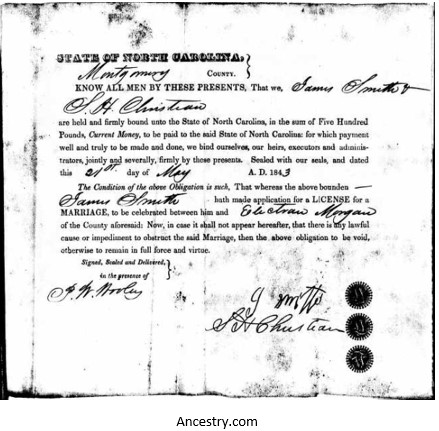
On 21 May 1843, a few weeks after the fire that destroyed the courthouse in Lawrenceville, James Smith obtained a marriage bond to wed Electra Ann Morgan, who is believed to be the daughter of Hardy and Nancy Hearne Morgan. S. H. Christian signed as the bondsman. I am not sure where the county was holding court after the courthouse fire, but it is obvious that the local officials quickly began the recovery process to put the town of Lawrenceville back in business.


Thus far, I have found no concrete proof that Electra Ann is the daughter of Hardy and Nancy Morgan, but the circumstantial evidence certainly leads in that direction. On the 1850 Census for Pontotoc, Mississippi, I found that James and Ann Smith migrated with several other Morgan’s from North Carolina to Mississippi. Their two oldest children, Mary and Sarah, were both born in North Carolina in 1844 and 1845, respectively. The two younger children, William and James, were born in Mississippi in 1847 and 1849, respectively. James Smith is listed as 32 years old, making him born about 1818 and Ann is listed as 30 years of age, being born about 1820.

In dwelling number 1848, two houses down from Hardy Morgan, lives Nelson Morgan, also born in North Carolina, with wife Narcissa, and children Amanda, Ann, Henrietta, Alfred and Mary. More on this family in another Blog, but suffice it to say that I believe Nelson is probably the son of Hardy and Nancy Morgan, and brother to Electra Ann Morgan Smith.


I found the marriage of James Smith and Electra Ann Morgan a bit curious as it was a James Smith who was witness to the will of Charles Morgan Senior in 1787, Chatham County, NC, and it is this same Charles Morgan Senior whom I am attempting to prove is the common ancestor for my Morgan line in Montgomery County. Could James Smith, who married Electra Ann Morgan in 1843, be a descendant of the James Smith who witnessed the will of Charles Morgan Senior in Chatham County? Did the Smith family migrate from Chatham into Montgomery with the Morgan and Stewart families? Certainly more research is required to straighten out this Smith line!


I am beginning to see why researchers who have studied the Chatham County Morgan’s believe that some of them migrated into Montgomery County. It is certainly true that Hardy Morgan did, as well as, John Stewart and his wife Rachel Morgan. If genealogy research was only finding common first and last names, this case would be solved for me. Unfortunately, just because someone has the same name does not necessarily prove they are the same person or of the same family. It is, though, a very beneficial clue and would be neglectful on my part if I did not investigate it further.

A James Smith had four land grants issued between 1780 and 1792 in Chatham County. Two of those grants were on the waters of Poke Berry (also seen as Pokeberry) Creek, a third on Wilkinsons Creek and the fourth on Cedar Creek.


Curious to know who else lived on or near Pokeberry Creek, I did a search on nclandgrants.com and discovered the infamous Mark Morgan also had a land grant for 600 acres on the Branches of Cub Creek and Pokeberry Creek in 1763, when the area was still Orange County. Chatham County would be formed from Orange in another 11 years, in 1771. Of note, Cedar Creek lies to the east and closer to what is now the Moore County line.

Updated 06-13-2020: Y-DNA testing has shown thus far that there is no connection between Mark Morgan descendants and the Hardy Morgan family. 


Mark Morgan is believed to be the son of John Dorian Morgan, born about 1650 in what is now south Wales and the youngest child of Edward Morgan. In the 1680s, John emigrated to Essex County, Virginia where he settled with this wife, Hannah. Their son, John Morgan, married Ann Barbee. John and Ann settled in Essex County, Virginia in St. Ann Parish on Occypacia Creek. Ann remarried after the death of her husband to Dr. Thomas Caruthers who sold all her property rights in 1739. The family moved to Onslow County, North Carolina where Ann died. Her sons had to start over acquiring their own property.

Ann’s son, Joseph Morgan, became one of the first Judges of Onslow County, North Carolina. Another son, William became the county Constable, and son, Nathan opened a trading post in the wilderness, trading with Indians. Another son, Mark Morgan (1712-1792), obtained 400 acres in then Bladen (now Orange) County, North Carolina on October 9, 1747. The property joined the South side of Newhope on Morgan Creek. Mark lived there with his wife Sarah Hinton until his death. (http://freepages.rootsweb.com/~jentaylor/genealogy/Morgan.htm)


Another interesting article I read at townofchapelhill.org in regards to Mark Morgan tells a history of this early North Carolina Morgan family that is ‘seldom seen in the family trees that bear his name.’ Mark Morgan married Sarah Hinton of the powerful North Carolina family ‘who developed plantations and built mills along the Neuse River in eastern Wake County. Extended kin to Mark and Sarah Hinton Morgan were the Barbee (Mark Morgan’s mother was a Barbee), Alston, Hardy (or Hardee), Hunter, Johnston, Jones, Kimbrough, Lane, and Patterson families.’

These families became the movers and shakers of early Orange, and later Chatham County, who ‘had the surplus and capital to invest in land, plantations, gristmills, sawmills and slaves. Mark and Sarah Hinton Morgan had at least four children (but probably more), sons John and Hardy and daughters Anne, married Benjamin Hart and Sarah, married first John Tapley Patterson (died of smallpox in VA 1781) and second, Benjamin Yeargan (also seen as Yeargain). It was from these families that land was donated to build the University of North Carolina in Chapel Hill.’

I am most curious of the names Hardy and Alston. It is a known fact that some children born to this era were named after their maternal families, most of the time their mothers maiden name. So, names are an important clue. The Hardy Morgan I am researching who migrated from Chatham into Montgomery bears the same name (Hardy) as the son of Mark Morgan. Was my Hardy Morgan the grandson of Mark Morgan? Or was his mother’s maiden name Hardy? Could Charles Morgan Senior be a son of Hardy Morgan, son of Mark Morgan?

I have not done much research on the Alston name yet, but my male cousin who Y-DNA tested for our Morgan line, Y-DNA matches to a descendant of Moses Alston Morgan from Tennessee. Collaborating with this match, I found out that Moses Alston Morgan was born 1803 and died in 1860. His parents were William Morgan and Martha Polly Reeder. The family lived in Wilson County Tennessee prior to 1800, yet Alston maintains he was born in North Carolina. It is certain that my cousin and the descendant of Moses Alston Morgan have a common ancestor. I hope to figure out how these Morgan families connect.


In reading through deeds in Orange County, I found a most interesting deed from David Davis to Hardy Morgan, son of Mark Morgan. Mentioned in the deed is 50 acres of land where Angelica Johnston whose husband (not named) is buried on said land and where she is to live during her natural life. Yet, another mystery, who is David Davis and Angelica Johnston?


Back in Montgomery County I found three land grants to a James Smith, definitely not the James that married Electra Ann Morgan, but perhaps the father or Uncle of the James that married Electra Ann Morgan. The first grant for 50 acres of land on the north east side of Pee Dee River adjoining John Christian’s second corner. Remember, S. H. Christian signed the marriage bond for James Smith and Electran Morgan in 1843? How is S.H. Christian related to John Christian? The grant is dated 7 Jun 1799.


The second grant, dated 17 Feb 1801, is for 100 acres of land on the Moccosin (Moccasin) Branch of McLains (McLeans) Creek and adjoins Purnell Hearn’s corner near the Great Road (current day Hwy 109) and intersects with James Harris’ corner. The Hearn’s and the Harris’ are a whole other Blog post. I have confirmed via the War of 1812 pension file that Nancy Morgan’s (wife of Hardy Morgan) maiden name is Hearn. She descends from one of these Hearn’s in Montgomery County, however, I am not sure which Hearn as yet.


The third grant, dated 30 Nov 1801, is for 30 acres on the north east side of Pee Dee River and adjoins John Christian’s corner. The Smith’s, Christian’s, Hearn’s, and Harris’ all seem to be established in Montgomery County before Hardy Morgan’s arrival around 1805/6. Hardy married Nancy Hearn in 1807 and her War of 1812 widow pension file claims he was born in 1785. There is not much wiggle room here. Hardy would have been about 21 years old when he left Chatham County for Montgomery.


By 1860, I have lost track of James and Electra Ann Morgan Smith. However, I found their two daughters, Mary Ann and Sarah H., living with Electra Ann’s sister, Nancy, and her husband Milton Ferguson in Drew, Spring Hill, Arkansas, where most of the Morgan family settled after leaving Mississippi.

Electra Ann Morgan Smith most likely died in Mississippi, either in childbirth or from some epidemic, perhaps like the one that killed her eldest brother, Alexander. James Smith and the two male children, William and James, have eluded me thus far.


The year 1870 finds Mary Ann Smith in Beauregard, Drew, Arkansas married to Hugh Johnson (H. J.) Donaldson and mother of two children, James W and Syntha (Cynthia). Living next door is Uncle Whitfield Morgan, and in his household lives Grandmother, Nancy Hearn Morgan.


In 1880, the Donaldson’s are found in Lincoln, Smith, Arkansas. Children include James, Hugh, John, Chester, and Whitfield. Syntha (Cynthia) is missing from this Census record and it is possible that she died between the Census years. As she was only 6 months old at the 1870 Census, she is not old enough to have married by 1880; perhaps she was just missed or overlooked by the Census taker. Three of the boys, John, Chester and Whitfield all grew up to marry sisters, Edna, Gertrude and Agnus Myhand.